


What Is a Shower Mixer? Types, Safety, and How to Choose
TL;DR:
- A shower mixer blends hot and cold water into a single, controlled stream before it reaches the showerhead. Choosing between thermostatic and manual models depends on safety, stability, and system compatibility. Proper installation style and matching to your water system are essential for optimal performance and maintenance.
A shower mixer is a valve that blends hot and cold water from separate supply lines into a single, controlled stream before it reaches the showerhead. Three practical points matter immediately:
- Thermostatic vs. manual control determines whether your temperature holds steady or drifts when someone flushes a toilet or runs the dishwasher.
- Installation style (exposed or concealed) affects both upfront cost and how easy the valve is to service later.
- Water system compatibility (tank-fed, combi boiler, or unvented) must be confirmed before you buy — the wrong mixer for your supply pressure will underperform regardless of price.
Table of Contents
- What does a shower mixer actually do?
- How does a shower mixer work inside the valve?
- What are the main shower mixer types?
- Exposed vs. concealed: which installation style fits your bathroom?
- Advantages and drawbacks of mixer showers
- What does a shower mixer cost, and will it work with your plumbing?
- How to choose the right mixer: checklist and questions for your plumber
- Expert guidance: matching mixer types to your home’s water system
- Key Takeaways
- The case for getting the valve choice right from the start
- Shower mixers and spare parts at Santehnikasveikals
What does a shower mixer actually do?
A shower mixer’s job is straightforward: it sits between your hot and cold supply lines and combines them at a ratio you set, so a single temperature exits at the showerhead. That sounds simple, but it replaces what older bathrooms handled with two separate taps — one scalding, one cold — that required constant manual adjustment.
The mixing happens inside the valve body, not at the showerhead. The showerhead itself only distributes water; the cartridge or valve inside the mixer controls the blend. This distinction matters when troubleshooting: a temperature problem is almost always a valve issue, not a showerhead issue.
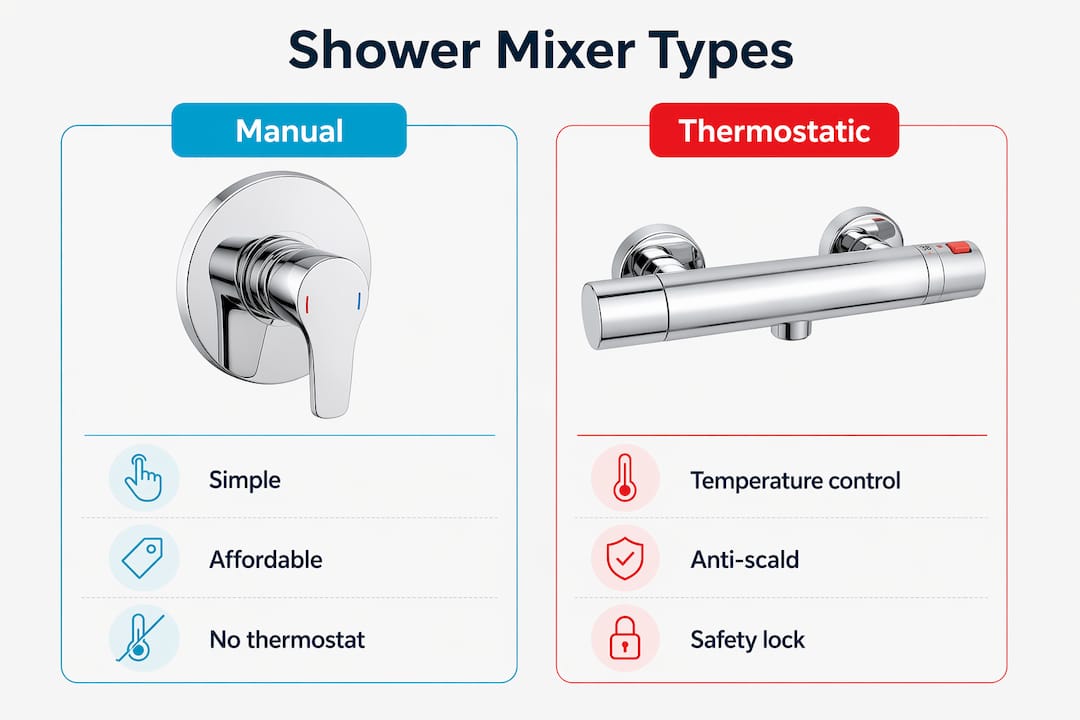
Mixer shower vs. electric shower vs. separate taps. An electric shower heats cold water on demand using an internal heating element, so it works even with no hot water supply. A mixer shower draws from your existing hot water source (boiler or tank) and blends it — no heating element, no electricity required for standard models. Separate taps give you independent hot and cold streams with no blending control at the valve level.
Common outlet configurations include single (one showerhead), dual (overhead plus handset), and triple (overhead, handset, and tub filler). Each additional outlet typically requires a diverter or multi-outlet valve to route water where you want it.
Pro Tip: If you plan to add a rainfall showerhead later, confirm your mixer valve supports the flow rate that head requires — undersized valves restrict performance even with strong supply pressure.
How does a shower mixer work inside the valve?
The core component is a cartridge — a precision-machined disc or cylinder that rotates or slides to open or close channels for hot and cold water. Turning the handle shifts the cartridge position, changing the proportion of each supply entering the mix chamber. The blended water then exits through a single outlet port toward the showerhead.
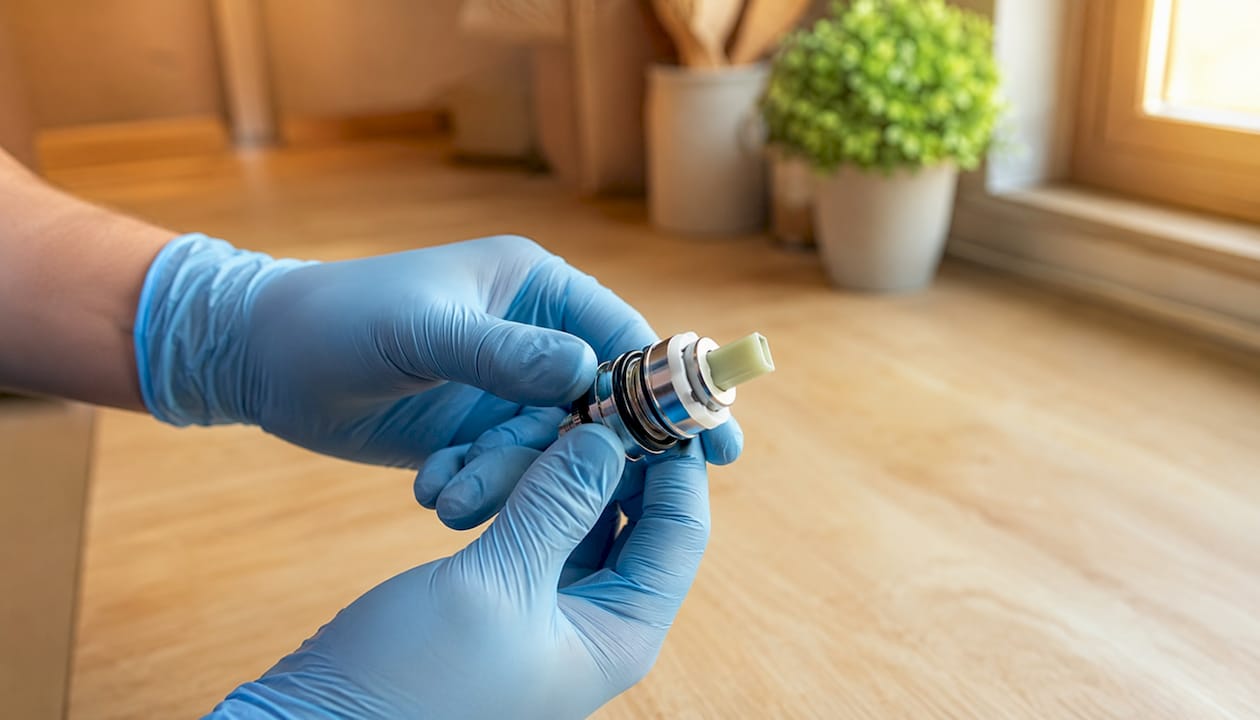
Two distinct mechanisms govern how mixers respond to supply changes.
Pressure-balancing valves detect a drop in one supply line and restrict the other to match. If cold pressure drops when a toilet flushes, the valve reduces hot flow proportionally, keeping the ratio stable. The response is reactive: it compensates after the pressure shift occurs, so there may be a brief temperature spike before the valve catches up.
Thermostatic valves use a wax or bimetallic element that expands and contracts with temperature changes. The element continuously adjusts the hot/cold ratio to hold the outlet temperature at the set point, regardless of supply fluctuations. The response is faster and more precise than pressure balancing alone.
The safety behavior of thermostatic mixers is the critical differentiator. Thermostatic mixers often include a default temperature limit commonly set at 38°C (100°F) and can automatically shut off flow if the cold water supply fails — preventing a full-hot blast from reaching the user. That automatic shutoff is not a feature on standard manual or pressure-balancing valves.
Balanced supply pressure matters for all mixer types. Significant pressure differences between hot and cold lines cause inconsistent temperatures and may require pressure-balancing valves or plumbing modifications to correct.
What are the main shower mixer types?
Mixers fall into two primary categories by control mechanism — manual and thermostatic — with digital and diverter/combination units as specialized variants. Each suits a different household profile.
Manual mixers
A single handle or two separate controls let you adjust hot and cold proportions by hand. The valve holds whatever position you set; it does not self-correct if supply conditions change.
- Pros: Lower purchase price, simpler cartridge, fewer components to service.
- Cons: Temperature drifts with supply fluctuations; no anti-scald shutoff.
- Best for: Households with stable, balanced supply pressure and no young children or older adults who need scald protection.
Thermostatic mixers
An internal thermostatic element monitors outlet temperature and adjusts the blend continuously. Thermostatic mixers maintain the set temperature despite supply fluctuations and typically include anti-scald protection for children and vulnerable adults.
- Pros: Consistent temperature, anti-scald shutoff on cold-water failure, programmable maximum temperature stop.
- Cons: Higher purchase price, more complex cartridge that may cost more to replace.
- Best for: Family homes, households with fluctuating supply pressure, or any setting where scald risk is a concern.
Digital and electronic mixers
A digital controller replaces the mechanical handle. You set a precise temperature on a panel or app; the valve opens to that preset when activated. Standard models require a low-voltage power connection (typically 12V via a transformer) routed to the valve location.
- Pros: Precise temperature presets, remote start capability, multiple user profiles on advanced models.
- Cons: Requires electrical supply at the valve, higher installation complexity, more components that can fail.
- Best for: Luxury bathroom builds or homeowners who want preset temperatures and remote activation.
Diverter and combination valves
A diverter valve routes water between two or more outlets — for example, switching between an overhead head and a handheld unit. Combination valves integrate thermostatic control with a built-in diverter, handling temperature and outlet selection from a single fixture.
- Pros: Clean installation for multi-outlet showers, single valve controls everything.
- Cons: If the valve fails, all outlets are affected simultaneously.
- Best for: Walk-in showers with overhead and handset configurations, or tub-and-shower combos.
Exposed vs. concealed: which installation style fits your bathroom?
Mixer showers install in exposed or concealed formats. The choice affects aesthetics, installation labor, and every future service call.
| Factor | Exposed valve | Concealed valve |
|---|---|---|
| Upfront cost | Lower — no wall opening required | Higher — wall prep and boxing-in adds labor |
| Aesthetics | Visible pipework and valve body | Clean wall face; only trim plate visible |
| Maintenance access | Direct — unscrew and service | Requires removing tiles or access panel |
| Future repair cost | Lower | Significantly higher — wall access often needed |
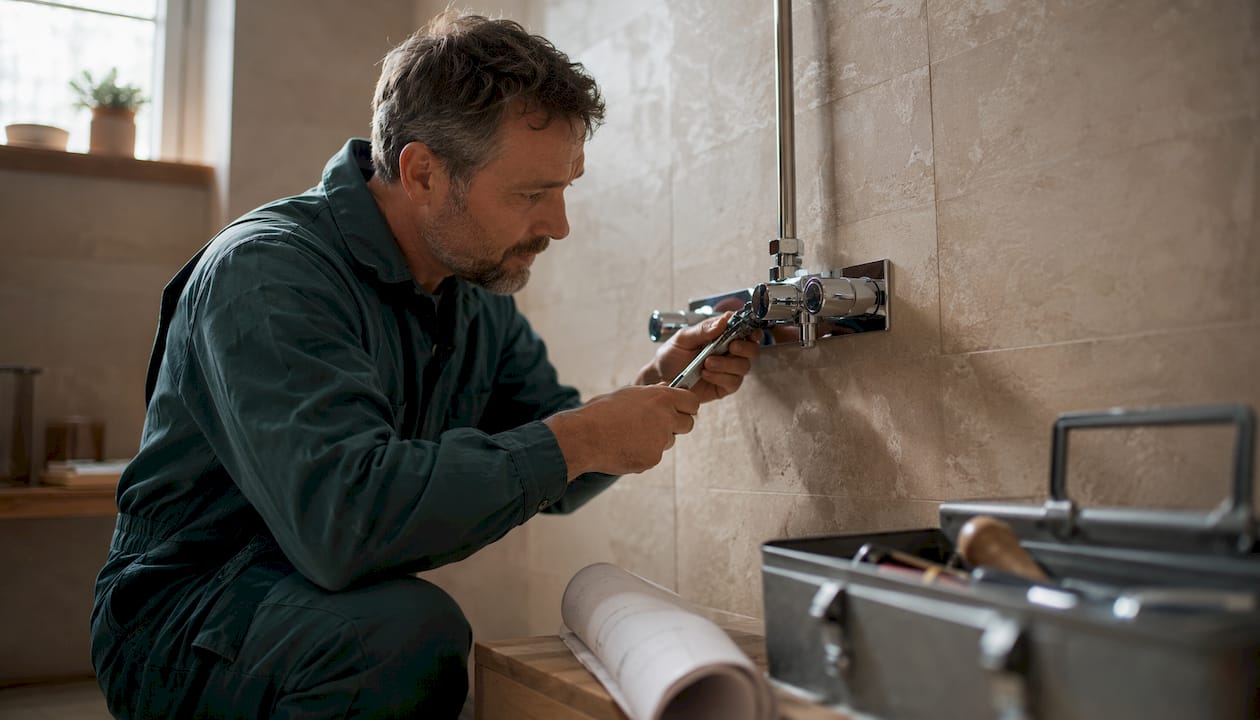
| Installation complexity | Standard plumbing work | Structural wall prep; not DIY-friendly |
Valve format options by outlet count:
- Single-control valve: One handle manages temperature and flow; suits single-outlet showers.
- Twin-handle valve: Separate controls for temperature and volume; common in exposed installations.
- Diverter valve (2- or 3-outlet): Routes flow between outlets; required for overhead plus handset setups.
- Integrated combination valve: Thermostatic control plus diverter in one body; used in multi-outlet walk-in showers.
Concealed valves can be significantly more expensive to service or replace because they often require opening the wall or removing tiles. That long-term cost is frequently underestimated at purchase time.
Advantages and drawbacks of mixer showers
Advantages:
- Single temperature control replaces the two-tap guessing game.
- Thermostatic models hold temperature steady across supply fluctuations.
- Multi-outlet configurations (overhead, handset, tub filler) from one valve.
- Generally the most economical shower choice where home hot water is already supplied by a boiler or water heater.
- No internal heating element means no electricity required for standard manual or thermostatic models.
Drawbacks are worth stating plainly. Mixer showers depend entirely on your existing hot water supply — if the boiler is off or the tank runs cold, you get cold water. They also will not increase low incoming water pressure; a weak supply produces weak flow regardless of the valve quality. Concealed valve installations create a long-term maintenance trade-off: the clean look costs more to service. And in homes with significantly unbalanced hot and cold pressures, additional plumbing work may be needed before the mixer performs correctly.
Pro Tip: For households with children or older adults, thermostatic control with anti-scald protection is the practical standard, not an upgrade. The automatic shutoff on cold-water failure is the feature that prevents serious burns.
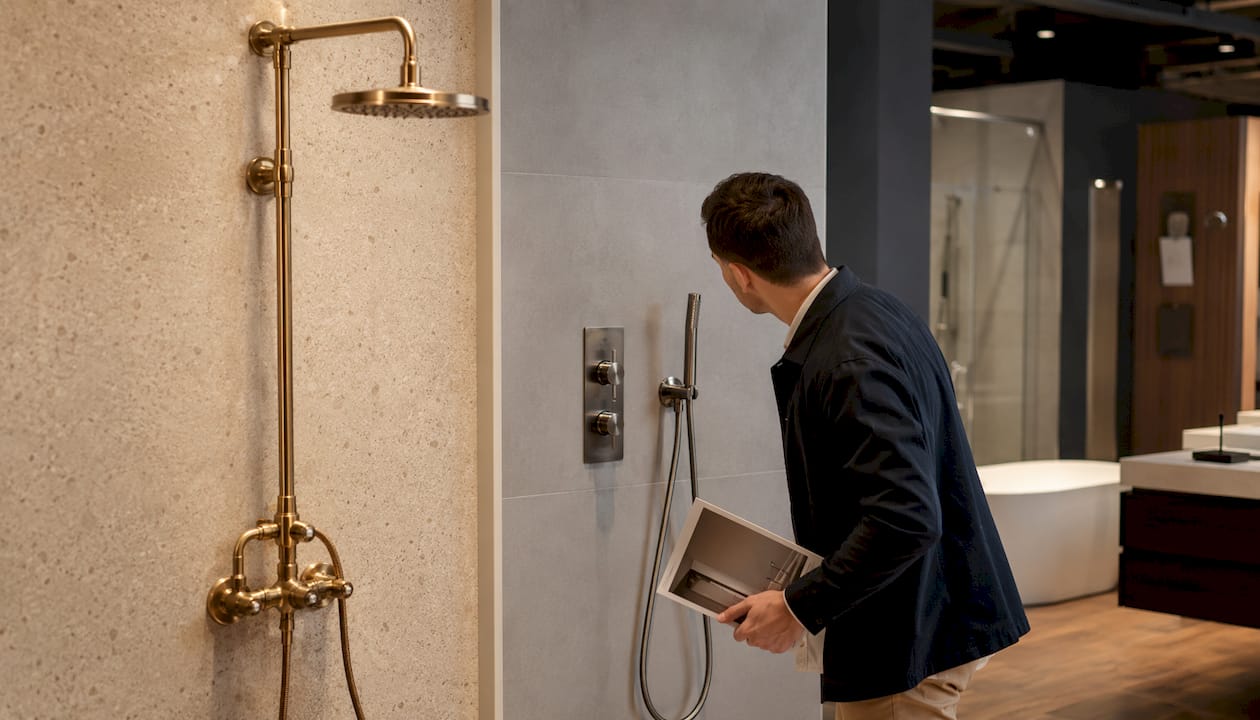
What does a shower mixer cost, and will it work with your plumbing?
Typical product price ranges in the U.S. market run roughly as follows (product only, before installation):
- Economy/manual: Entry-level pressure-balancing valves start at an affordable price range.
- Mid-range thermostatic: Quality thermostatic valves are generally priced in a moderate range.
- Premium/digital: High-specification thermostatic or digital systems are premium-priced, with luxury multi-outlet systems costing significantly more.
Finish (chrome, brushed nickel, matte black) and outlet count push prices toward the higher end of each band. Installation labor adds to the total: a straightforward exposed valve swap by a licensed plumber typically costs less than a concealed valve installation that requires wall opening, re-routing pipes, or adding isolation valves.
Compatibility checklist before you buy:
- Water heater type: Tank-type water heater, combi boiler, or tankless unit — mixers work across all three when correctly specified, but flow rate and pressure characteristics differ.
- Supply pressure balance: Hot and cold lines should be at similar pressure. Significant imbalance requires a pressure-balancing valve or plumbing modification.
- Minimum pressure requirement: Check the valve manufacturer’s minimum dynamic pressure spec; gravity-fed systems with low head pressure may fall below it.
- Electricity: Standard manual and thermostatic mixers need no power. Digital mixers require a low-voltage supply at the valve location.
- Red flag: If your home has very low or highly unbalanced supply pressure, address that first — a mixer will not compensate for it.
How to choose the right mixer: checklist and questions for your plumber
Work through these items before purchasing.
Decision checklist:
- Confirm your water system type (tank, combi, tankless) and measure or estimate supply pressure.
- Decide on thermostatic or manual based on household safety needs and supply stability.
- Choose exposed or concealed installation based on wall construction and long-term service access.
- Determine outlet count (single, dual, triple) and whether a diverter or combination valve is needed.
- Set a realistic budget covering both product and installation labor.
- Verify spare-part availability for the specific valve model before committing.
Questions to ask your plumber:
- What is the dynamic pressure on my hot and cold supply lines, and are they balanced?
- Does my wall construction support a concealed valve, and is a service access panel feasible?
- What isolation valves will be needed, and are they already present?
- Does this valve model have readily available cartridges and spare parts?
- What warranty does the valve carry, and who handles warranty service in this area?
Red flags to watch for:
- Incompatible supply pressures with no plan to correct them.
- A thermostatic valve without a cold-water failure shutoff.
- A concealed valve installation in an older wall with no provision for future access.
- A plumber who skips pressure testing before specifying the valve.
For DIY-capable homeowners, reviewing plumbing tools and preparation steps before attempting any valve work is worth the time — even if you plan to hire out the main installation.
Expert guidance: matching mixer types to your home’s water system
Industry specialists recommend choosing a mixer based first on the home’s water system and second on household safety needs. That order matters because a thermostatic valve specified for a high-pressure unvented system may not perform correctly on a low-head gravity-fed supply.
Thermostatic vs. pressure-balancing: the practical difference. A pressure-balancing valve reacts to pressure changes after they occur. A thermostatic valve monitors actual outlet temperature and corrects continuously. For households where supply pressure fluctuates during normal use — running appliances, multiple fixtures open simultaneously — thermostatic mixers are the preferred choice for both comfort and safety.
Maintenance trade-offs by installation style:
- Exposed valves: cartridge replacement is a straightforward service call; no wall damage.
- Concealed valves: future cartridge access typically requires removing tiles or cutting an access panel; budget for that cost from day one.
- Both types benefit from annual descaling in hard-water areas to extend cartridge life.
Pro Tip: If your home has a gravity-fed system with low head pressure, ask your plumber about a dedicated pump or a pumped shower system before specifying any mixer valve. A mixer cannot fix low pressure, and a valve rated for higher pressure will underperform or fail to open correctly.
Expert consensus on thermostatic safety: Thermostatic cartridges actively monitor outlet temperature and adjust hot/cold proportions; advanced models add automatic shutdown on cold failure and programmable maximum temperature stops. For family homes or any setting with vulnerable users, that active monitoring is the standard to specify, not an optional feature.
Key Takeaways
A thermostatic shower mixer with anti-scald protection is the practical standard for family homes, and the choice between exposed and concealed installation determines your long-term maintenance cost as much as the valve itself.
| Point | Details |
|---|---|
| Core function | A shower mixer blends hot and cold supply lines into a single controlled temperature at the showerhead. |
| Thermostatic priority | Choose thermostatic over manual for family homes or any supply with pressure fluctuations; the anti-scald shutoff is the key safety feature. |
| Exposed vs. concealed | Exposed valves cost less to service; concealed valves look cleaner but require wall access for future repairs. |
| System compatibility | Confirm supply pressure balance and water heater type before buying — mixers work across combi, tank, and unvented systems when correctly specified. |
| Santehnikasveikals | Browse thermostatic shower valves and spare parts at Santehnikasveikals, with product pages covering specifications for compatibility checks. |
The case for getting the valve choice right from the start
Most homeowners focus on finish and price when selecting a shower mixer. The valve type and installation format are the decisions that actually determine whether the shower performs well five years from now.
The distinction between thermostatic and manual is not a luxury question. In a home where supply pressure fluctuates — which describes most U.S. homes with multiple bathrooms or shared supply lines — a manual valve will drift in temperature every time another fixture opens. A thermostatic valve corrects for that continuously. The 38°C default limit and cold-water shutoff are not marketing features; they are the mechanism that prevents a scalding incident when cold supply pressure drops unexpectedly.
The choice between concealed and exposed deserves the same scrutiny. A concealed valve looks better. It also means that when the cartridge wears out in year seven, the repair involves tile removal. Many homeowners make that trade-off knowingly; the problem is that most make it without knowing it at all. Designers note that many homeowners underestimate long-term maintenance costs for concealed valves — the initial aesthetic gain can be outweighed by expensive future repairs.
Specify the valve for your actual water system, not the one you wish you had. A high-spec thermostatic valve on a low-pressure gravity-fed supply will disappoint. Match the valve to the supply first, then optimize for features and finish.
Shower mixers and spare parts at Santehnikasveikals
Santehnikasveikals carries a full range of shower mixer valves — manual, thermostatic, and combination units — alongside spare cartridges and installation accessories. For homeowners planning a bathroom update, the product catalog includes specification details that help confirm compatibility with your water system before purchase.
The ORAS CUBISTA thermostatic shower valve is one example of a concealed thermostatic unit with full specification data available on the product page — useful for checking pressure requirements and cartridge part numbers before scheduling installation. For a broader look at available fixtures and parts, the Santehnikasveikals store catalog covers the full range with pricing and availability. If you are unsure which valve suits your supply system, the product pages include technical specifications to review with your plumber before committing to a purchase.
Recommended
- How to Replace a Faucet: A DIY Guide for Homeowners | Santehnikasveikals.lv
- Advantages of Modern Sinks for Your Home Renovation | Santehnikasveikals.lv
- Augstspiediena mazgātājs Bosch EasyAquatak 120, 1500 W, 120 Bar 06008A7901 - 06008A7901
- Step by Step Plumbing: A Practical DIY Guide | Santehnikasveikals.lv
Atstājiet komentāru