





















































Energy Efficiency in Buildings: Benefits, Strategies, and ROI

Energy efficiency is the primary, cost-effective lever for reducing building energy use and emissions while improving occupant health and asset value. The U.S. Department of Energy, ENERGY STAR / U.S. EPA, and the International Energy Agency consistently rank it as the fastest, most cost-effective path to decarbonization in the built environment. Buildings constructed under current energy codes can use significantly less energy than older stock — before a single solar panel is installed.
That last point is the core of the “first fuel” principle: reduce demand first, then size renewables to match a smaller load. ASHRAE’s position document on energy efficiency in buildings states this directly, recommending that high-performance envelope work, HVAC selection, and commissioning be completed before any on-site renewable system is specified.
- Buildings account for a substantial share of global energy-related CO2 emissions, per MDPI’s 2025 review.
- Code-compliant new construction can cut energy use significantly compared to pre-code stock.
- Replacing fossil fuel boilers with high-efficiency heat pumps can substantially reduce heating energy use in targeted applications.
Pro Tip: Before specifying any renewable energy system, complete a full energy model of the building. Oversizing solar or wind to compensate for a leaky envelope is a common, expensive mistake.
Key Takeaways
Energy efficiency is the highest-ROI decarbonization lever available to building owners, and the “first fuel” principle — reduce demand before adding renewables — is the organizing framework that makes every other investment more cost-effective.
| Point | Details |
|---|---|
| Prioritize envelope and passive design | Address insulation, air sealing, and glazing before specifying HVAC or renewables to right-size all downstream systems. |
| Benchmark with Portfolio Manager | Use ENERGY STAR Portfolio Manager to establish EUI baselines and identify the lowest-performing assets in your portfolio. |
| Include NEBs in the business case | Health, productivity, and fiscal impacts can push benefit-to-cost ratios to 4:1 — present these to ownership alongside energy savings. |
| Bundle measures for incentives | Grouped projects qualify for higher utility rebate tiers and reduce procurement costs compared to single-measure submissions. |
| Start with a pilot, then scale | A documented pilot creates the cost and savings template needed to replicate results across a full portfolio. |
Table of Contents
- What are the primary benefits of energy efficiency in buildings?
- What strategies deliver the most energy savings in buildings?
- How does energy efficiency differ between new construction and retrofits?
- How do you measure building energy performance and finance improvements?
- How does energy efficiency support ESG goals and decarbonization?
- What does the research say about the “first fuel” principle?
- How do you start an energy-efficiency program for a building or portfolio?
- The efficiency-first approach still faces real barriers
- Sources
What are the primary benefits of energy efficiency in buildings?
The direct financial case is straightforward: lower energy consumption reduces utility bills and peak demand charges. For commercial owners, operational energy costs are one of the largest controllable line items in a building’s budget. The U.S. EPA identifies energy efficiency as one of the fastest ways to stabilize electricity prices and cut greenhouse gas emissions across both residential and commercial sectors.
The more compelling argument, though, comes from non-energy benefits (NEBs). The IEA’s multiple-benefits framework shows that health, productivity, and fiscal impacts can materially shift the investment case. An OECD analysis found benefit-to-cost ratios as high as 4:1 when health and well-being outcomes are included alongside energy savings.
Key benefit categories:
- Cost reduction. Lower energy bills, reduced demand charges, and predictable operating expenses across the asset lifecycle.
- Emissions reduction. Direct cuts to Scope 1 and Scope 2 carbon, reducing reliance on offsets and renewable energy procurement.
- Occupant health and productivity. Better thermal comfort, air quality, and daylighting reduce absenteeism and increase cognitive performance in office and school settings.
- Grid and resilience benefits. Lower peak demand reduces exposure to price spikes and grid stress events, a growing concern as extreme weather becomes more frequent.
- Public budget effects. Reduced energy burden on households and lower public health costs from improved indoor air quality generate measurable fiscal returns at the municipal and state level.
- Job creation. Retrofit programs and high-performance construction support skilled trades, manufacturing, and engineering employment.
What strategies deliver the most energy savings in buildings?
High-impact measures follow a clear hierarchy: passive design and envelope performance first, then mechanical systems, then controls and monitoring. Renewables come last.
Passive design and high-performance envelope
Insulation, air sealing, high-performance glazing, and thermal mass reduce the building’s base load before any mechanical system runs. In new construction, integrated design — where the architect, mechanical engineer, and energy modeler work together from schematic design — captures these gains at minimal incremental cost.
High-efficiency HVAC and water heating
Variable air volume (VAV) systems, energy recovery ventilators, and heat pump technology are the core tools here. For a practical overview of system selection and operational best practices, the HVAC guide from Santehnikasveikals covers the key technology categories. Upgrading old radiators is a lower-cost entry point for existing buildings — replacing outdated heating equipment with modern, efficient alternatives cuts both fuel consumption and maintenance costs.

LED lighting and controls
Payback periods in commercial buildings are often under three years.
Commissioning and retro-commissioning
Commissioning a new building verifies that systems operate as designed. Retro-commissioning an existing building finds and corrects operational drift — controls sequences that have degraded, dampers stuck open, setpoints that were never optimized.
Building automation and fault detection
Building automation systems (BAS) with fault detection and diagnostics (FDD) identify equipment failures and inefficiencies in real time. In large commercial portfolios, FDD software can surface savings opportunities that manual audits miss.
Prioritizing passive and envelope measures before mechanical upgrades is not just good practice — it determines the correct equipment size. A building with poor insulation will always require oversized HVAC, and oversized equipment runs inefficiently and wears out faster. Get the load right first.
Pro Tip: When sequencing a retrofit, bundle air sealing and insulation with HVAC replacement. A smaller, correctly sized heat pump installed after envelope work costs less upfront and performs better than a large unit installed before it.
How does energy efficiency differ between new construction and retrofits?
The decision framework, cost timing, and available tools differ significantly between new builds and existing stock.
In new construction, the opportunity is integration. Passive design choices — orientation, massing, window-to-wall ratio, shading — cost nothing to change at the design stage and everything to fix after construction. The International Energy Conservation Code (IECC) sets the minimum performance baseline for new U.S. buildings, and many states have adopted more stringent versions. ASHRAE Standard 90.1 serves as the commercial energy code reference in most jurisdictions. Buildings that meet current IECC requirements can use significantly less energy than pre-code stock, a gap that compounds over a building’s lifecycle.
Retrofits operate under different constraints. Existing buildings carry sunk costs in their envelope and systems, tenant occupancy limits access windows, and split incentives — where the owner pays for upgrades but tenants capture the savings — remain a persistent barrier in leased commercial space. The practical response is phased improvement: address the highest-impact, lowest-disruption measures first (controls, lighting, retro-commissioning), then schedule envelope and mechanical work during natural replacement cycles.
New construction vs. retrofit: key decision drivers
| Factor | New construction | Retrofit |
|---|---|---|
| Cost timing | Incremental cost at design stage is low | Capital investment required; phasing needed |
| Disruption | None — integrated from the start | Tenant and operational disruption likely |
| Code compliance | Mandatory at permitting | Triggered by major renovation thresholds |
| Carbon payback | Immediate from occupancy | Depends on measure depth and embodied carbon |
| Design flexibility | High — all systems can be optimized | Limited by existing structure and systems |
For compliance alignment, understanding plumbing and building standards is a practical starting point for both new projects and major renovations. Integrated policy packages combining codes, incentives, and technical assistance are the most effective mechanism for scaling efficiency across both segments, per IEA analysis.
How do you measure building energy performance and finance improvements?
Key metrics
Energy Use Intensity (EUI) — measured in kBtu per square foot per year — is the standard metric for comparing building performance across types and sizes. A lower EUI indicates better performance. ASHRAE energy audits (Level 1 through Level 3) provide progressively detailed opportunity assessments, from a walkthrough survey to a full investment-grade analysis.
ENERGY STAR Portfolio Manager is the primary U.S. benchmarking platform. It normalizes EUI for weather, occupancy, and operating hours, then scores buildings on a 1–100 scale against peers. A score of 75 or above qualifies for ENERGY STAR certification. Portfolio Manager also integrates with many utility data feeds, reducing manual data entry for large portfolios.
Pro Tip: Bundle multiple efficiency measures into a single project scope before applying for utility rebates or tax credits. Many programs calculate incentives on whole-project energy savings, so a bundled project often qualifies for higher incentive tiers than individual measures submitted separately.
Financing options
| Financing route | Best for | Risk profile |
|---|---|---|
| Utility rebates | Lighting, HVAC, controls upgrades | Low — direct incentive, no repayment |
| Federal/state tax credits | Capital equipment, new construction | Low-medium — requires tax liability |
| ESCO performance contracts | Large portfolios, public buildings | Low — savings guarantee covers debt service |
| PACE financing | Commercial property owners | Medium — repaid via property tax assessment |
| Green loans / bonds | Large-scale retrofits, new builds | Medium — market-rate debt, ESG reporting benefit |
The U.S. DOE supports federal incentive programs and workforce development that reduce the cost and risk of efficiency investments across building types. Utility rebate programs vary by state and provider but remain one of the most accessible entry points for smaller building owners.
How does energy efficiency support ESG goals and decarbonization?
Energy efficiency is the foundation of any credible Scope 1 and Scope 2 decarbonization strategy. Cutting actual energy consumption reduces direct emissions and purchased electricity emissions before any offset or renewable energy certificate is applied. For sustainability leads, this distinction matters: offsets are increasingly scrutinized in ESG disclosures, while verified energy reductions are auditable and durable.
The asset valuation link is direct. Lower operating expenses improve net operating income (NOI), and higher NOI supports higher asset valuations in income-capitalization models.
A 10% reduction in energy costs in a commercial office building with a 5% cap rate adds roughly $2 of asset value for every $1 of annual savings — a leverage ratio that makes efficiency one of the highest-return capital investments available to building owners.
Reporting platforms like ENERGY STAR Portfolio Manager provide the performance data that feeds into disclosure frameworks. Measurabl is one example of an ESG data management platform used by real estate portfolios to aggregate Portfolio Manager data, track progress against science-based targets, and prepare disclosures for frameworks such as GRESB and CDP. The combination of verified performance data and structured reporting is what converts efficiency investment into credible ESG disclosure.
What does the research say about the “first fuel” principle?
The evidence base for prioritizing efficiency before renewables is broad and consistent across authoritative sources.
Buildings account for roughly one-third of global energy-related CO2 emissions and a comparable share of final energy consumption, per the MDPI review of decarbonization strategies. ASHRAE’s position document explicitly recommends that envelope performance, HVAC selection, and commissioning precede any renewable energy specification. The IEA’s multiple-benefits analysis adds that including health, productivity, and fiscal impacts in the investment case can produce benefit-to-cost ratios as high as 4:1.
The IPCC AR6 Working Group III report formalizes this as the Sufficiency–Efficiency–Renewables (SER) hierarchy: optimize use and space first. Then improve envelope and systems, and finally add renewables. This sequence minimizes lifecycle costs and avoids the common error of sizing renewable generation to cover an inefficient load.
The multiple-benefits framing also changes how payback periods look. Including reduced absenteeism and productivity gains in a financial model can shorten the apparent payback of a deep retrofit significantly — in some industry analyses, productivity gains alone exceed the value of energy savings.
How do you start an energy-efficiency program for a building or portfolio?
A structured sequence reduces risk and maximizes the chance that early projects generate the data needed to scale.
- Establish a baseline. Enter all buildings into ENERGY STAR Portfolio Manager. Calculate EUI for each asset and identify the bottom quartile performers — those are the highest-opportunity targets.
- Commission an energy audit. An ASHRAE Level 1 audit identifies no- and low-cost opportunities. A Level 2 audit provides the engineering analysis and financial modeling needed to build a business case. Engage a certified energy auditor or commissioning provider.
- Build the business case with NEBs. Quantify energy savings, then add health, productivity, and resilience benefits. Present the full benefit-to-cost ratio to finance and ownership stakeholders, not just simple payback.
- Run a pilot project. Select one building or floor for a bundled measure implementation. Document the process, costs, and verified savings. This creates the template for portfolio-wide rollout.
- Bundle measures and procure strategically. Group envelope, mechanical, lighting, and controls work into a single scope. Bundling captures higher utility incentive tiers and reduces mobilization costs.
- Commission all installed systems. Commissioning verifies that new equipment operates as specified and that controls sequences are correctly programmed. Skip this step and a significant share of projected savings will not materialize.
- Measure and verify results. Use ENERGY STAR Portfolio Manager to track post-implementation EUI. Compare against the baseline and report results to stakeholders and disclosure frameworks.
Pro Tip: Pilot projects work best when they include a tenant or occupant engagement component. Buildings where occupants understand and support efficiency goals consistently outperform those where changes are made without communication.
The efficiency-first approach still faces real barriers
The evidence for prioritizing energy efficiency in buildings is clear. The execution is harder.
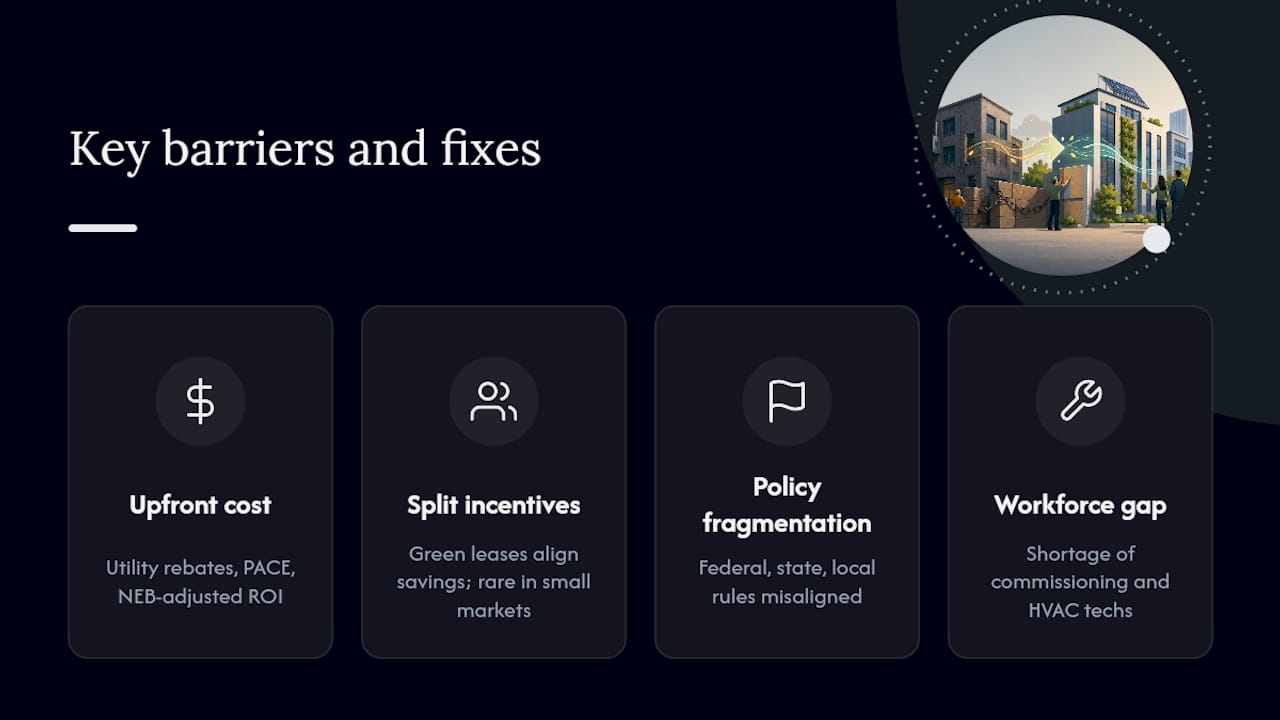
Upfront capital remains the most cited barrier, particularly for smaller building owners who lack access to ESCO financing or green loan markets. The mitigation is straightforward in principle: use utility rebates and PACE financing to reduce or eliminate out-of-pocket costs, and present the full NEB-adjusted ROI rather than simple payback to ownership.
Split incentives in leased commercial space are more structurally difficult. Where tenants pay utility bills directly, owners have limited financial motivation to invest in efficiency upgrades. Green lease provisions — which align owner and tenant interests through shared savings clauses — are gaining traction in institutional real estate but remain uncommon in smaller markets.
Policy fragmentation compounds both problems. Federal tax credits, state rebate programs, and local building codes operate on different timelines and eligibility rules, creating administrative complexity that discourages smaller owners from pursuing available incentives. The IEA’s recommendation for integrated policy packages — combining codes, incentives, and technical assistance — addresses this directly, but implementation varies widely by state.
The workforce gap is real and underappreciated. Commissioning, fault detection, and high-performance HVAC installation require skilled technicians who are in short supply in many U.S. markets. Investing in workforce development alongside technology deployment is not optional — it determines whether installed systems actually perform as specified.
Sources
- Local Energy Efficiency Benefits and Opportunities | US EPA
- Energy Efficiency and Decarbonization Strategies in Buildings: A Review of Technologies, Policies, and Future Directions – MDPI
Atstājiet komentāru