




















































Sustainable Plumbing Benefits for Homeowners: 2026 Guide
Sustainable plumbing cuts household water and energy use while improving property resilience and resale value. The benefits of sustainable plumbing are measurable at the utility bill level, not just in theory.
Top benefits at a glance:
- Lower water bills from reduced-flow fixtures and efficient appliances
- Lower energy bills from less hot water demand and reduced standby losses
- Reduced environmental footprint through lower water withdrawals and fewer leaks
- Lower leak and water-damage risk with smart detection systems
- Improved property marketability and resilience against supply disruptions
The sections below cover which upgrades deliver the best payback, how to prioritize them, and what certifications and rebates to look for.
Key Takeaways
Sustainable plumbing upgrades deliver measurable water and energy savings, reduce leak and damage risk, and improve property resilience, with the fastest payback coming from low-cost fixture swaps.
| Point | Details |
|---|---|
| Start with fixture swaps | WaterSense aerators, showerheads, and toilets offer the shortest payback, often under 2–4 years. |
| Water use reduction potential | A water-efficient design can cut indoor water use by roughly 20–50% depending on measures and behavior. |
| Add smart leak detection early | Flow monitors and sensors prevent costly water damage, not just utility waste. |
| Check rebates before purchasing | Utility rebates and federal tax credits for ENERGY STAR water heaters can shorten payback significantly. |
| Santehnikasveikals | Carries WaterSense and ENERGY STAR-compatible fixtures, faucets, and heating systems for residential upgrades. |
Table of Contents
- 1. How sustainable plumbing actually reduces water and energy use
- 2. Common eco-friendly plumbing upgrades and their trade-offs
- 3. Advanced systems: rainwater harvesting, greywater reuse, and water recycling
- 4. Costs, payback timelines, and a sample savings calculation
- 5. Incentives, certifications, and labels worth knowing
- 6. How to prioritize upgrades and what to ask your contractor
- 7. Research-backed evidence on property value, resilience, and material choices
- Santehnikasveikals: fixtures and supplies for efficient plumbing upgrades
- Sources
1. How sustainable plumbing actually reduces water and energy use
The core mechanism is demand reduction. Low-flow fixtures deliver fewer gallons per minute (gpm) at the tap and fewer gallons per flush (gpf) at the toilet, so less water moves through the system. Less water moved means less water heated, which directly cuts energy consumption. A water-efficient plumbing design can reduce indoor water use by roughly 20–50%, depending on the measures chosen and household behavior.
Distribution efficiency compounds those savings. Shorter hot-water runs, right-sized piping, and insulated supply lines reduce the volume of cold water that must be purged before hot water arrives at the fixture. That purge volume is pure waste. Recirculation systems address the same problem in larger homes by keeping hot water close to the point of use.
Leak reduction is a separate but significant channel. A slow drip at a faucet or a running toilet can waste hundreds of gallons per month before a homeowner notices. Smart leak sensors and flow monitors catch those losses early, which means the savings are not just on the utility bill but in avoided water damage and repair costs.
- Fixture flow rate (gpm) directly controls both water and hot-water energy consumption
- Pipe insulation reduces wait-time waste and standby heat loss
- Smart sensors shift leak detection from reactive to preventative
Pro Tip: Photograph your water meter reading before and after any fixture upgrade and compare it against the same billing period the prior year. That single comparison gives you a real payback number, not an estimate.
2. Common eco-friendly plumbing upgrades and their trade-offs
Low-flow toilets, showerheads, and faucet aerators
Water-saving toilets certified under the EPA WaterSense program use 1.28 gpf or less, compared with 3.5–7 gpf for pre-1994 models. WaterSense-labeled showerheads flow at 2.0 gpm or less without a noticeable pressure drop in most installations. Faucet aerators are the lowest-cost upgrade available, often under $10 per fixture.
- Pros: Low upfront cost, no structural changes, immediate bill impact, widely available
- Cons: Older homes with low water pressure may need a pressure check before installing low-flow showerheads; dual-flush toilets require user habit change
Efficient water heaters: heat-pump, tankless, and high-efficiency tank
ENERGY STAR-qualified water heaters include heat-pump, tankless (on-demand), and high-efficiency storage models. Heat-pump water heaters move heat from surrounding air rather than generating it, making them significantly more efficient than standard electric resistance units. Tankless systems heat water only when a tap opens, eliminating standby losses. The U.S. Department of Energy notes that tankless units work best in homes with moderate hot-water demand and adequate gas supply or electrical capacity.
- Pros: Lower operating costs over the unit’s life; heat-pump models qualify for federal tax credits
- Cons: Higher upfront cost than standard tanks; tankless units may require upgraded gas lines or electrical panels; heat-pump units need adequate surrounding air volume
Pipe insulation and right-sized piping
Insulating hot-water supply lines is a low-cost action that reduces standby heat loss and shortens wait times at fixtures. Right-sizing pipes, as Plumbing & Mechanical reports, also reduces embodied material use and can mitigate stagnation risk in low-flow scenarios.
- Pros: Low material cost, DIY-accessible for accessible runs, immediate energy impact
- Cons: Concealed pipes require opening walls; improper sizing can create flow or stagnation problems
Smart fixtures and leak-detection systems
Smart plumbing systems include whole-home flow monitors, individual sensor pucks, and Wi-Fi-enabled shutoff valves. These devices detect abnormal flow patterns, alert homeowners to slow leaks, and can shut off supply automatically during a burst event.
- Pros: Prevents catastrophic water damage; some insurers offer premium discounts for monitored systems
- Cons: Upfront device cost; requires Wi-Fi connectivity and periodic battery or firmware maintenance
3. Advanced systems: rainwater harvesting, greywater reuse, and water recycling
These systems go beyond fixture swaps and address the source of water supply itself. They carry higher complexity and cost but can offset a meaningful share of household water demand.
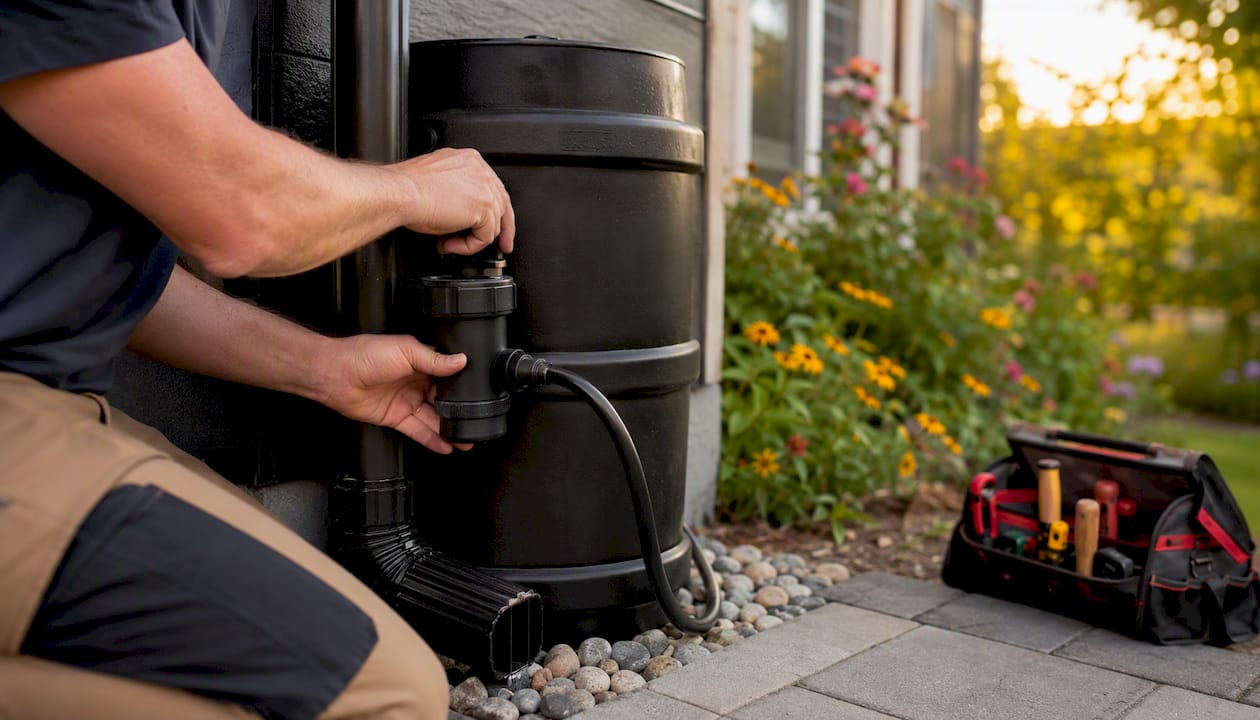
Rainwater harvesting captures roof runoff in cisterns for non-potable uses: toilet flushing, irrigation, and in some jurisdictions, laundry. The water-efficient design guide includes sizing formulas for capture volume based on roof area and local rainfall data. Typical residential systems range from simple rain barrels to underground cisterns with first-flush diverters and filtration.
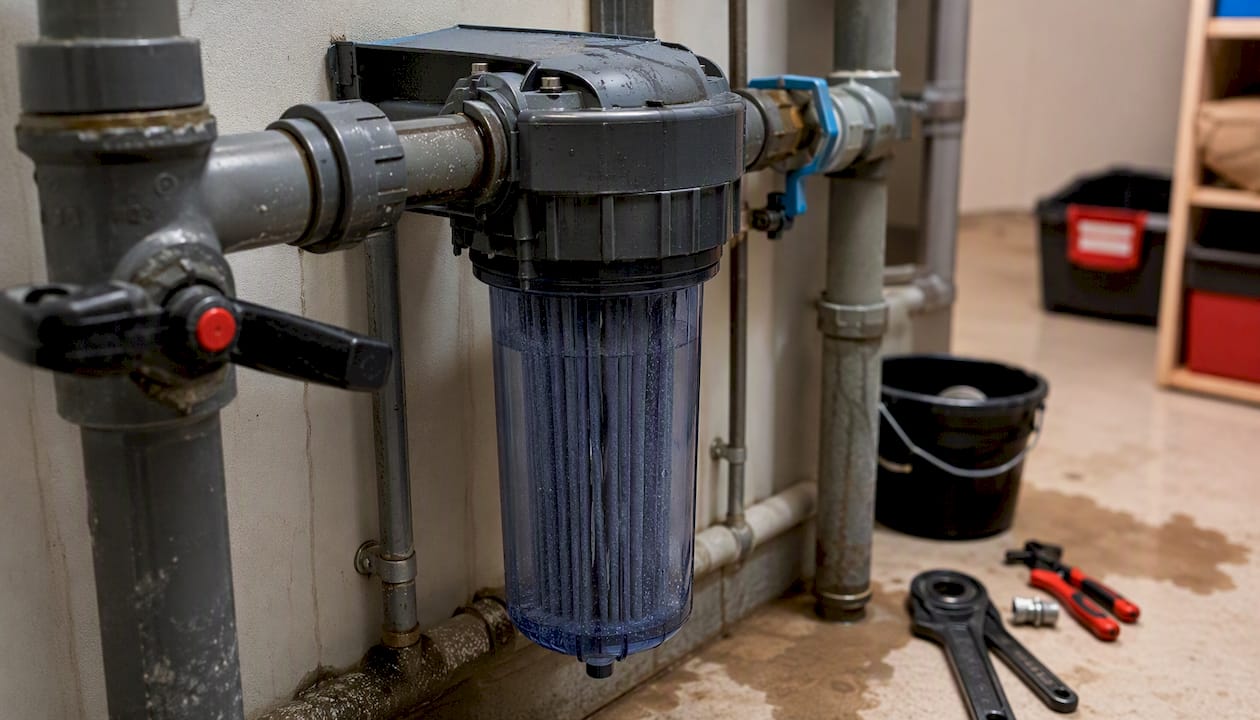
Greywater reuse redirects drain water from sinks, showers, and laundry to subsurface irrigation or toilet flushing. Greywater contains soap and biological material, so systems require filtration and must comply with local health codes. Many states allow simple laundry-to-landscape systems without a permit; more complex indoor reuse systems typically require one.
Closed-loop home water recycling treats and recirculates all non-toilet wastewater. These systems are rare in single-family residential construction and are primarily found in net-zero or off-grid builds. Maintenance demands and water-quality monitoring requirements are significant.
Viewing these systems as resilience planning rather than just utility savings is the right frame. Rainwater capture and greywater reuse reduce dependence on municipal supply during drought restrictions or service interruptions.
- Pros: Meaningful water offset, reduced municipal demand, resilience during supply disruptions
- Cons: Permitting required in most jurisdictions; maintenance and water-quality monitoring; higher upfront cost; not all systems are legal in every state
Check your local plumbing regulations and municipal utility rules before specifying any reuse system. Greywater and rainwater rules vary significantly by state and county.
4. Costs, payback timelines, and a sample savings calculation
Upfront costs and payback periods vary widely by upgrade type, local water and energy rates, and household size. The table below shows typical ranges for common upgrades.
| Upgrade | Typical Install Cost | Typical Annual Savings | Rough Payback |
|---|---|---|---|
| Faucet aerators (whole home) | $20 | $50 | Under 1 year |
| WaterSense showerheads | $150 | $150 | 1–2 years |
| WaterSense toilet (per unit) | $350 | $150 | 2–4 years |
| Tankless water heater | $350 | $150 | 5–12 years |
| Heat-pump water heater | $350 | $350 | 4–10 years |
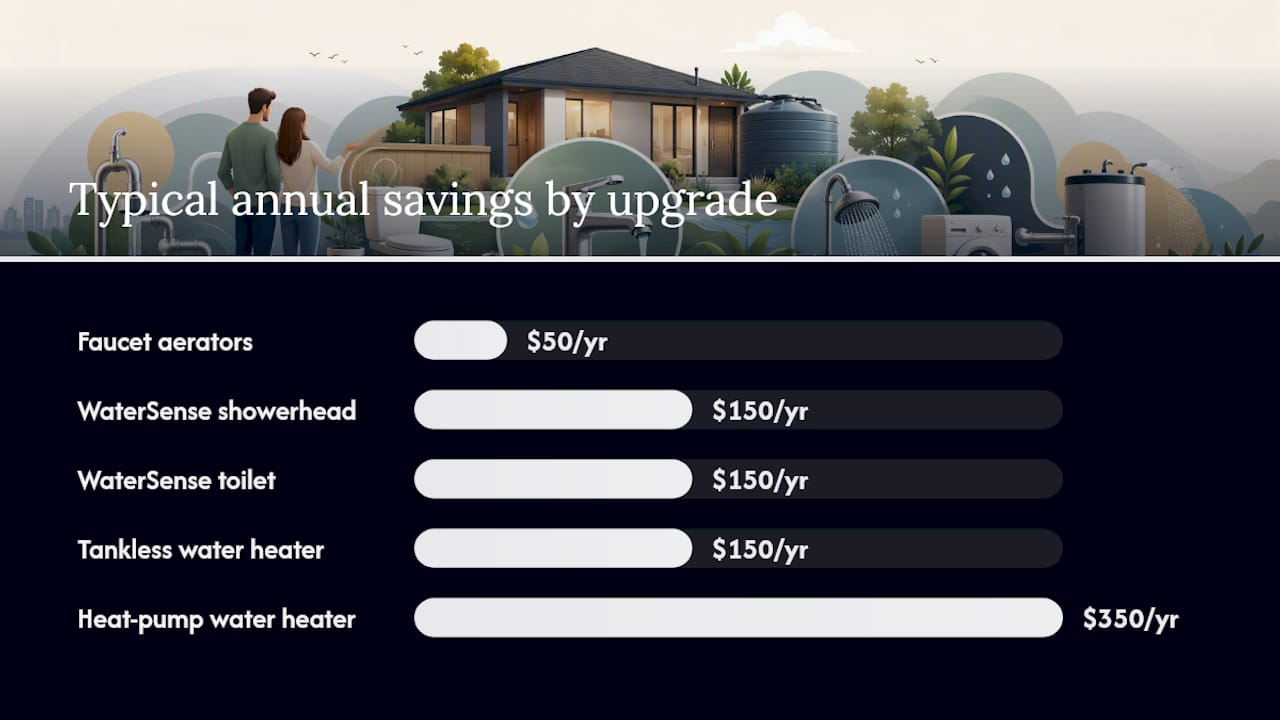
Savings ranges reflect variation in local water and energy rates, household size, and prior fixture efficiency. Federal tax credits and utility rebates can shorten payback significantly.
Sample calculation for a WaterSense toilet replacement:
- Old toilet: 3.5 gpf. New WaterSense toilet: 1.28 gpf. Difference: 2.22 gpf.
- Household flushes per day (average 4-person home): approximately 20 flushes.
- Daily savings: 20 × 2.22 = 44.4 gallons.
- Annual savings: 44.4 × 365 = approximately 16,206 gallons.
- At a water rate of $0.01 per gallon (a common mid-range U.S. rate), annual bill savings: approximately $162.
- At a fixture cost of $350 installed: payback in roughly 2.2 years.
Factors that shift payback: higher local water rates accelerate it; rebates from your utility can cut the net cost by $50–$150 per fixture. Household size and flush frequency matter too.
5. Incentives, certifications, and labels worth knowing
EPA WaterSense
The WaterSense label identifies fixtures that meet EPA performance and efficiency standards. Products must be independently certified, not just manufacturer-claimed. EPA WaterSense statistics document measurable national water savings from certified products and programs. When purchasing toilets, showerheads, or faucets, verify the WaterSense listing number on the EPA’s product search tool, not just the label on the box.
ENERGY STAR
ENERGY STAR certification for water heaters documents that qualifying models reduce energy use compared with standard models. Ask for the ENERGY STAR product ID when purchasing a water heater; this ID is required for most utility rebate applications.
Utility and municipal rebates
Most U.S. utilities offer rebates for WaterSense toilets, high-efficiency washing machines, and ENERGY STAR water heaters. Rebate amounts vary by utility and change annually. Check the ENERGY STAR Rebate Finder and your local water utility’s website before purchasing any major fixture or appliance.
Safer Choice for cleaning products
The EPA’s Safer Choice program labels cleaning products formulated to be safer for water systems and indoor air. The American Lung Association notes that conventional cleaning chemicals can affect indoor air quality. Using Safer Choice products in bathrooms and kitchens reduces chemical load on greywater and septic systems.
- Verify WaterSense listing numbers on EPA’s product search, not just the package label
- Request the ENERGY STAR product ID for any water heater before purchase
- Check your utility’s rebate page and the ENERGY STAR Rebate Finder before buying
- Ask for spec sheets and certification documentation from your contractor
6. How to prioritize upgrades and what to ask your contractor
Prioritization sequence
Start with the highest-impact, lowest-cost actions. Follow a step-by-step interior plumbing design approach:
- Audit first. Read your water meter and review 12 months of utility bills. Identify the largest use categories (toilet, shower, irrigation).
- Swap fixtures. Replace aerators, showerheads, and toilets with WaterSense-certified models. These deliver the fastest payback.
- Insulate and right-size. Insulate accessible hot-water lines. If remodeling, right-size supply piping to reduce purge volume and stagnation risk.
- Add smart detection. Install a whole-home flow monitor or individual leak sensors, particularly near water heaters, washing machines, and under sinks.
- Upgrade the water heater. Replace at end of life with a heat-pump or tankless model. Replacing a functioning unit early rarely pencils out unless rebates are large.
- Consider reuse systems. Evaluate rainwater harvesting or greywater reuse only after completing steps 1–5 and confirming local code allows it.
Questions to ask a plumbing contractor
- Do you have experience specifying and installing WaterSense and ENERGY STAR products?
- Can you pull the required permits for this work, including any reuse system permits?
- What warranty do you offer on labor, and what does the manufacturer warranty cover?
- Will you commission the system after installation and provide baseline flow readings?
- Can you install or integrate a leak-detection sensor or flow monitor as part of this project?
Red flags to watch for:
- Contractor proposes skipping permits for a greywater or rainwater system
- No product documentation or certification numbers provided
- Vague claims about savings percentages with no supporting data or product specs
- No commissioning or post-installation testing offered
7. Research-backed evidence on property value, resilience, and material choices
The advantages of eco-friendly plumbing extend beyond utility bills. Industry reporting frames green plumbing as resilience planning: leak detection and rainwater capture reduce insurance and catastrophic-damage risk, not just monthly costs. Buyers and tenants increasingly view water-smart systems as value-adds that future-proof properties.
On the material side, Plumbing & Mechanical reports that right-sizing pipework, selecting lower global-warming-potential materials, and efficient layouts reduce embodied carbon and can support Legionella mitigation when done properly. The choice between copper, PEX, and PVC involves lifecycle trade-offs: copper has higher embodied energy in primary production, but recycled copper significantly lowers that footprint. PEX has lower embodied energy in production but raises questions about long-term recyclability.
Key statistic: A well-executed water-efficient plumbing design can reduce indoor water use by roughly 20–50% depending on the measures chosen and behavior change.
Pro Tip: When specifying pipe materials for a renovation, ask your contractor for Environmental Product Declarations (EPDs) or recycled-content documentation. This takes five minutes and gives you verifiable lifecycle data rather than marketing claims.
The practical case for treating sustainability as resilience
Sustainable plumbing decisions made at the fixture and system level tend to pay back in utility savings within a few years. The less-discussed payback is in risk reduction. A home with smart leak detection, insulated lines, and right-sized piping is less likely to produce a $15,000 water-damage claim. Some insurers already price that risk differently. As water rates rise in drought-stressed regions, the resilience argument for rainwater capture and greywater reuse will only strengthen. The cost-saving plumbing ideas that deliver the best long-term return are the ones that address both the utility bill and the tail risk simultaneously.
Santehnikasveikals: fixtures and supplies for efficient plumbing upgrades

Replacing fixtures with WaterSense-certified models or upgrading to an ENERGY STAR water heater starts with finding the right products at a price that keeps payback timelines short. Santehnikasveikals carries a broad catalog of plumbing fixtures, faucets, shower cabins, toilets, sinks, heating systems, pipes, and installation accessories, with product catalogs and price calculators available directly on the site. Whether you are swapping aerators across a rental portfolio or specifying a heat-pump water heater for a full renovation, the Santehnikasveikals storefront gives you product options, specifications, and ordering in one place. Browse the catalog, confirm product specs against WaterSense or ENERGY STAR listings, and order the fixtures your contractor needs before the job starts.
Sources
- Epa
- How to Design a Water-Efficient Plumbing System (2026)
- Advancing sustainability in commercial plumbing systems | Plumbing & Mechanical
- Wri
Palikite komentarą