




















































Communal Boiler Systems Explained for Property Managers
A communal boiler system is a centralized heating arrangement where one shared boiler, or a group of boilers, supplies heat and hot water to multiple dwellings within a single building. Instead of each apartment running its own gas boiler, the heat is generated in a central plant room and distributed through insulated pipes to every connected unit. Residents receive heat via a Heat Interface Unit (HIU) installed inside their home, which transfers heat from the central network and includes a thermostat and heat meter for individual control and consumption tracking.
Three main piping configurations exist in communal heating systems:
- 2-pipe systems: Hot water circulates continuously through a single supply and return loop, providing heat and hot water at all times. The boiler cannot be shut down without cutting hot water to all units.
- 3- or 4-pipe systems: Separate pipework for heating and hot water allows each to be controlled independently, giving property managers more scheduling flexibility.
- Heating-only systems: Supply heat during colder months and shut down overnight and through summer, since no domestic hot water runs through the network.
Table of Contents
- How does a communal boiler system work?
- How communal heating differs from district heating
- Benefits and drawbacks of communal boiler systems
- What to consider before choosing a communal heating system
- Santehnikasveikals: heating components for multi-home projects
- Key Takeaways
How does a communal boiler system work?
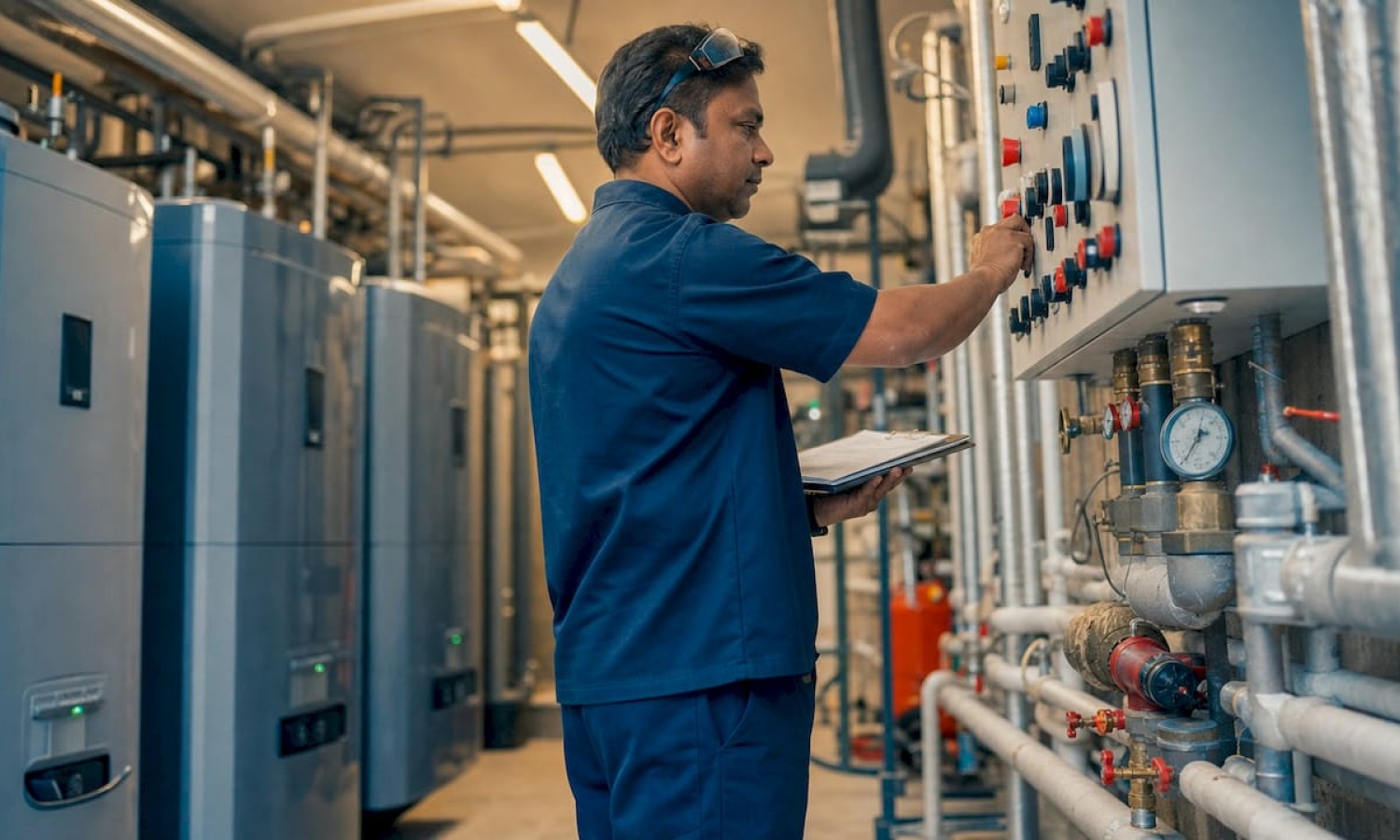
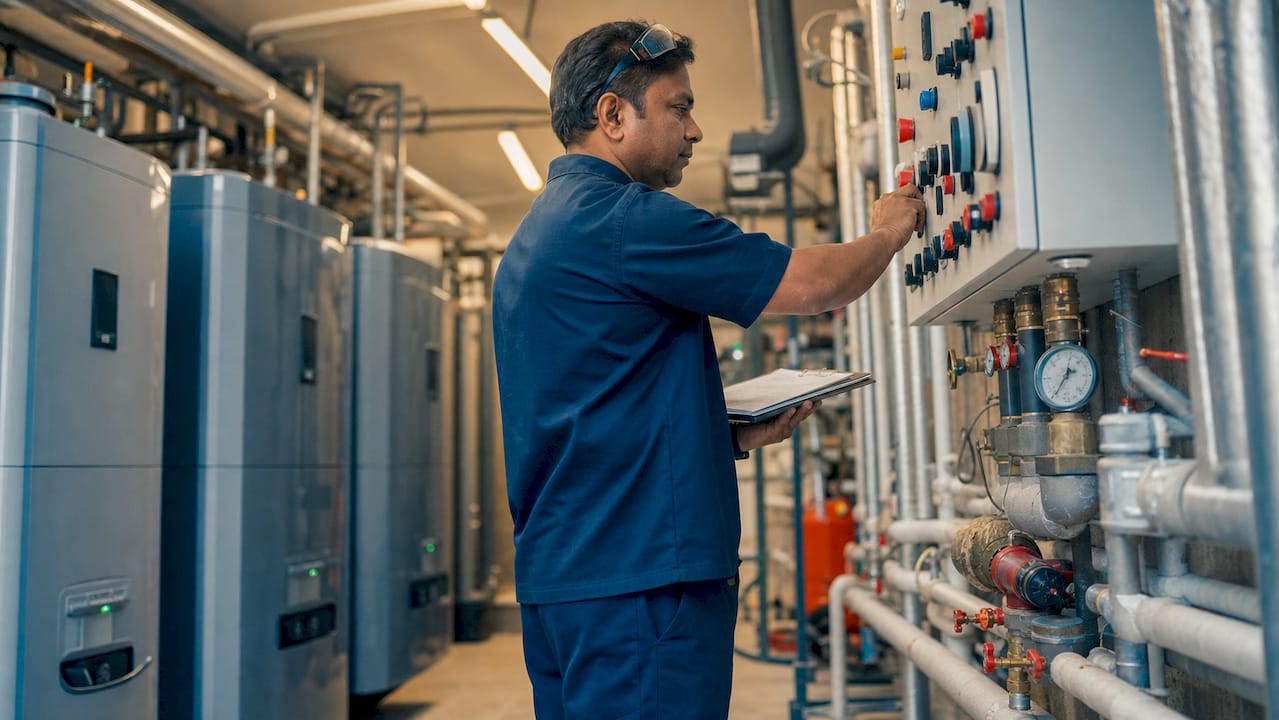
The central energy center houses one or more boilers or heat pumps. These heat water, which then travels through a network of insulated distribution pipes to each dwelling. A return loop carries cooled water back to the energy center for reheating, keeping the cycle continuous.
Inside each apartment, the HIU does the actual work of transferring heat into the home. Many residents mistake the HIU for a boiler, but it generates no heat itself. It simply exchanges thermal energy from the central network into the apartment’s radiators or underfloor heating, while the heat meter records exactly how much energy each unit consumes.
Key operational components at a glance:
- Central plant room: Boilers or heat pumps, often located in a building’s basement
- Insulated pipe network: Carries hot water to units and returns cooled water for reheating
- Heat Interface Unit (HIU): Transfers heat into the individual apartment; does not generate heat
- Heat meter: Measures each resident’s consumption for billing purposes
- Thermostat and thermostatic radiator valves (TRVs): Allow residents to adjust room temperatures
Boiler operating schedules vary by system type. Heating-and-hot-water systems often run 18 hours per day during colder months, with reduced output overnight, while 2-pipe configurations run continuously to keep hot water available around the clock. In summer, heating-only systems shut down entirely, while combined systems keep running to supply domestic hot water.
How communal heating differs from district heating
Both communal and district heating distribute heat from a central source through insulated pipes, but the scale and infrastructure differ considerably. Communal heating serves multiple dwellings within a single building, such as an apartment block, with the energy center typically located on-site in the building’s basement or plant room. District heating, by contrast, supplies heat across multiple buildings or entire neighborhoods, often from a large off-site facility.
Key distinctions:
- Scale: Communal systems are confined to one building or site; district networks can span kilometers.
- Heat source location: Communal boilers sit on-site; district heating plants are usually remote.
- Fuel and waste heat: District systems sometimes capture industrial waste heat or use large-scale combined heat and power plants, options rarely practical at the single-building level.
- Billing complexity: District networks involve more parties and infrastructure, making cost allocation more complex than a single-building communal setup.
For property managers evaluating options, the practical difference comes down to who owns and operates the energy center. In a communal system, that responsibility stays within the building’s management structure.
Benefits and drawbacks of communal boiler systems
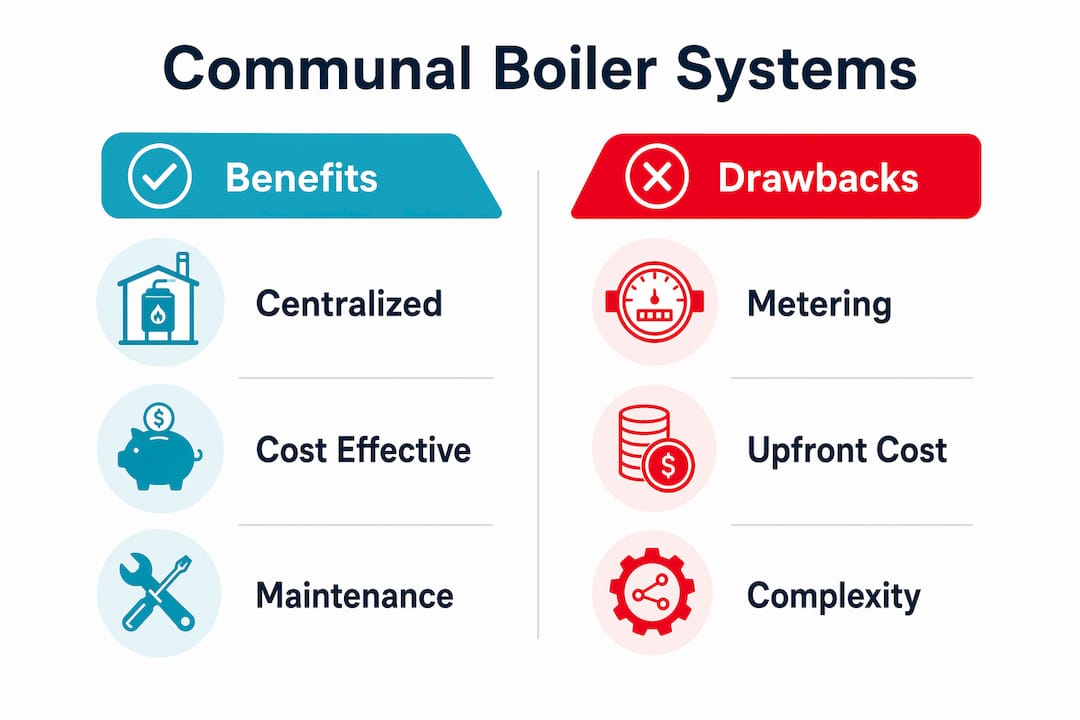
Centralizing heating equipment in a shared plant room frees up valuable space inside each apartment. No boiler cupboard, no flue penetrations through exterior walls, no annual gas safety certificate per unit. For developers building dense residential blocks, that space reclaim across dozens of units adds up quickly.
Benefits:
- Space efficiency: no individual boiler required in each apartment
- Centralized maintenance reduces per-unit service costs and coordination burden
- Potential energy savings from optimized central heat generation versus multiple smaller boilers running independently
- Single maintenance contract covers the entire building
Drawbacks:
- Limited individual control, particularly in 2-pipe systems where the boiler runs continuously
- Billing complexity when costs are pooled rather than individually metered
- Residents in pooled-billing setups have less incentive to reduce consumption, since savings are shared across all units
- Full dependency on central system uptime; a boiler fault affects every connected apartment simultaneously
Pro Tip: Clear, individual metering is the single most effective way to align resident behavior with energy costs. Pooled billing simplifies administration but tends to increase overall consumption because no individual resident bears the direct cost of their own usage.
What to consider before choosing a communal heating system
Choosing the right setup requires matching system type to building size, resident expectations, and long-term operating costs. A heating-only system suits climates with mild summers and no demand for centrally supplied domestic hot water. A 3- or 4-pipe system costs more to install but gives property managers independent control over heating and hot water schedules, which matters in buildings with varied occupancy patterns.

Billing and metering:
Individual heat meters give residents direct visibility into their consumption, which Citizens Advice notes is a key factor in resident satisfaction on heat networks. Pooled billing reduces administrative overhead but can leave residents feeling disconnected from their actual energy use.
Maintenance responsibilities:
Maintenance typically falls to the property manager or the communal heating provider, not individual residents. This centralized upkeep model is one of the system’s practical advantages, but it requires a clear service agreement that defines response times, emergency coverage, and scheduled inspections.
Regulatory and safety standards in the US:
Communal boiler systems in the US must comply with local building codes, ASME Boiler and Pressure Vessel Code standards, and applicable EPA emissions requirements. State and municipal regulations vary, so confirming compliance with local authorities before installation is necessary. Energy efficiency standards under ASHRAE 90.1 also apply to commercial and multi-family residential buildings and influence system design choices.
Questions to ask before adoption:
- Which piping configuration fits the building’s heating and hot water demand profile?
- Will billing be individual-metered or pooled, and how will disputes be handled?
- Who holds the maintenance contract, and what are the guaranteed response times?
- Does the system design meet current ASME and local code requirements?
- What is the plan for system upgrades or boiler replacement as equipment ages?
Upgrading the distribution components, such as old radiators, can also affect overall system efficiency once a communal boiler is in place.
Santehnikasveikals: heating components for multi-home projects
Residents and property managers who understand their communal heating setup often find the next step is sourcing the right components, whether that means replacement radiators, pipe fittings, or supplemental heating units for spaces the central system does not fully cover.

Santehnikasveikals carries a broad catalog of heating and plumbing materials suited to multi-home residential projects, from steel panel radiators to electric convectors for supplemental room heating. The platform offers clear product specifications, competitive pricing, and delivery across a wide service area, making it a practical source for property managers sourcing components at scale. For individual residents looking to add a backup heating option, the heating product catalog includes electric convectors and panel radiators available for direct purchase without a minimum order requirement.
Key Takeaways
A communal boiler system centralizes heat generation in one plant room, distributes it through insulated pipes, and delivers it to individual apartments via Heat Interface Units, removing the need for a separate boiler in each unit.
| Point | Details |
|---|---|
| System definition | One central boiler supplies heat and hot water to all units in a building via insulated pipes. |
| Three piping types | 2-pipe, 3/4-pipe, and heating-only configurations each offer different control and efficiency trade-offs. |
| HIU function | Heat Interface Units transfer heat into apartments but do not generate it; they include a meter and thermostat. |
| Billing method matters | Individual metering aligns resident incentives with consumption; pooled billing simplifies admin but reduces conservation motivation. |
| Santehnikasveikals | Offers heating components, radiators, and plumbing materials suited to communal and multi-home heating projects. |
Оставьте комментарий