





















































Best Practices for Facility Plumbing Managers Should Follow

Implement a risk-ranked preventive maintenance program that pairs regular inspections with valve exercising and documented commissioning, and you eliminate most of the emergency calls that eat facility budgets. Start today: exercise every isolation valve, install or clean strainers at grease-prone fixtures, and add an annual backflow test to your calendar. These three actions, grounded in standards like ASHRAE Standard 188 for Legionella control, ANSI Z358.1 for emergency eyewash and shower stations, and WaterSense fixture guidance, form the backbone of best practices for facility plumbing.
- Exercise isolation and shutoff valves periodically, and log full open/close stroke
- Install or inspect strainers at kitchens, mechanical rooms, and floor drains
- Schedule the annual backflow preventer test now, before your local deadline hits
- Verify hot water temperatures against ASHRAE 188 Legionella thresholds
Key Takeaways
A risk-ranked preventive maintenance program built on valve exercising, strainer upkeep, backflow testing, and documented commissioning prevents most facility plumbing emergencies before they start.
| Point | Details |
|---|---|
| Exercise valves quarterly | Full open/close stroke, logged in your CMMS, so emergency shutoffs actually work under pressure. |
| Test backflow assemblies annually | Certified testing protects against contamination and satisfies regulatory audits. |
| Follow risk-based inspection cadence | Match daily, weekly, monthly, and annual checks to asset criticality, not a flat schedule. |
| Choose mechanical drain care first | Strainers and enzymatic cleaners protect older pipes better than caustic chemicals. |
| Source durable, spec-matched parts | Santehnikasveikals supplies lead-free valves, strainers, and cleanout hardware built for commercial-grade specs. |
Table of Contents
- Why Facility Plumbing Guidelines Matter More Than Most Teams Realize
- The Core Best Practices Checklist for Facility Plumbing Systems
- How Often Should You Inspect Facility Plumbing Assets?
- What Should You Do When a Plumbing Problem Shows Up?
- How Should You Manage Valves and Tag Them for Emergencies?
- What Documentation Do You Need for Commissioning and Audits?
- What Is the Safest Way to Handle Drains and Cleaning Chemicals?
- What Should Procurement Specs Require for Facility Plumbing Materials?
- How Do You Choose a Reliable Plumbing Contractor?
- A Facility Manager’s Take on Sequencing These Priorities
- Where to Source Reliable Plumbing Parts for Facility Maintenance
- Sources
Why Facility Plumbing Guidelines Matter More Than Most Teams Realize
Plumbing failures rarely stay contained. A cracked union or a stuck isolation valve turns into flooded server rooms, shut-down kitchens, or a Legionella exposure that lands your facility in a regulatory review. Occupant safety, regulatory risk, operational continuity, and cost control all trace back to the same set of habits.
Backflow contamination and Legionella growth are the two risks regulators care about most, which is why ASHRAE Standard 188 exists as a formal water management program framework, and why ANSI Z358.1 mandates weekly activation of emergency eyewash and shower stations. Skip either one and you are not just risking a fine. You are risking a preventable illness or injury with your name on the incident report.
The financial case is just as direct. A risk-driven preventive maintenance program built around an accurate asset inventory and tailored inspection frequencies cuts emergency plumbing calls, because most emergency calls trace back to a maintenance task that got skipped, not a system that failed unpredictably. Frequency should follow risk, not habit. A grease interceptor near a commercial kitchen needs far more attention than a rarely used utility sink two floors up.
The Core Best Practices Checklist for Facility Plumbing Systems
This is the ranked list to hand your team and start converting into CMMS tasks this week. Each item includes what “done” looks like, so nobody has to guess whether a task actually got completed.
- Build a risk-ranked asset inventory. Map every fixture, valve, pump, and backflow assembly by criticality. Done means every asset has an ID, location, and inspection frequency assigned.
- Exercise isolation and emergency shutoff valves quarterly. Full stroke, open to close, with position logged. A valve that will not turn during an emergency is worse than no valve at all.
- Install and maintain strainers at high-debris points. Kitchens, laundry rooms, and mechanical equipment drains need strainers checked monthly, cleaned as needed.
- Test backflow prevention assemblies annually, minimum. Local code may require more often. Done means a signed certificate from a certified tester on file.
- Verify water heater temperature and pressure relief valves twice yearly. Set domestic hot water to balance Legionella control against scald risk, following ANSI Z358.1 guidance for emergency fixtures.
- Regulate incoming water pressure. Test at the main and at remote fixtures; anything consistently above 80 psi needs a pressure-reducing valve inspection.
- Keep cleanouts accessible and clearly marked. No storage racks or equipment blocking access, per UC Davis facility standards.
- Winterize exposed and unconditioned piping before the first freeze. Insulate, heat-trace where required, and drain any lines feeding unheated spaces.
- Run a documented Legionella water management program. Follow ASHRAE 188 for temperature control, flushing of low-use outlets, and disinfection protocols.
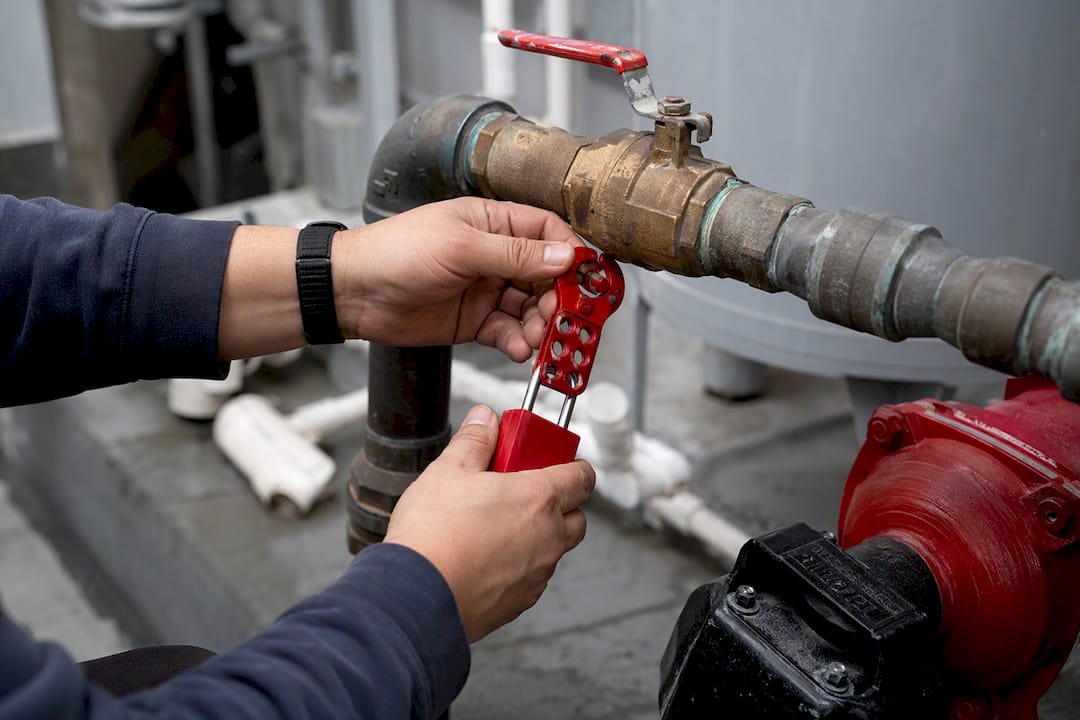
- Lock out and tag equipment before any valve or pump service. No exceptions, regardless of how routine the task seems.
- Log every inspection, repair, and test in a centralized system. Paper logs get lost; a CMMS entry does not.
Pro Tip: Schedule valve exercising during your lowest-occupancy window, then pair it immediately with a flushing protocol on distal outlets. This knocks out two maintenance goals in one visit and avoids the stagnant-water conditions that let Legionella take hold.
How Often Should You Inspect Facility Plumbing Assets?
Cadence should track risk, not convenience. A facilities maintenance checklist from ServiceChannel recommends daily visual checks, weekly pressure and drain checks, monthly corrosion inspections, and annual comprehensive reviews of water heaters, sump pumps, and backflow devices. Build your schedule around that logic and assign clear ownership for each task.
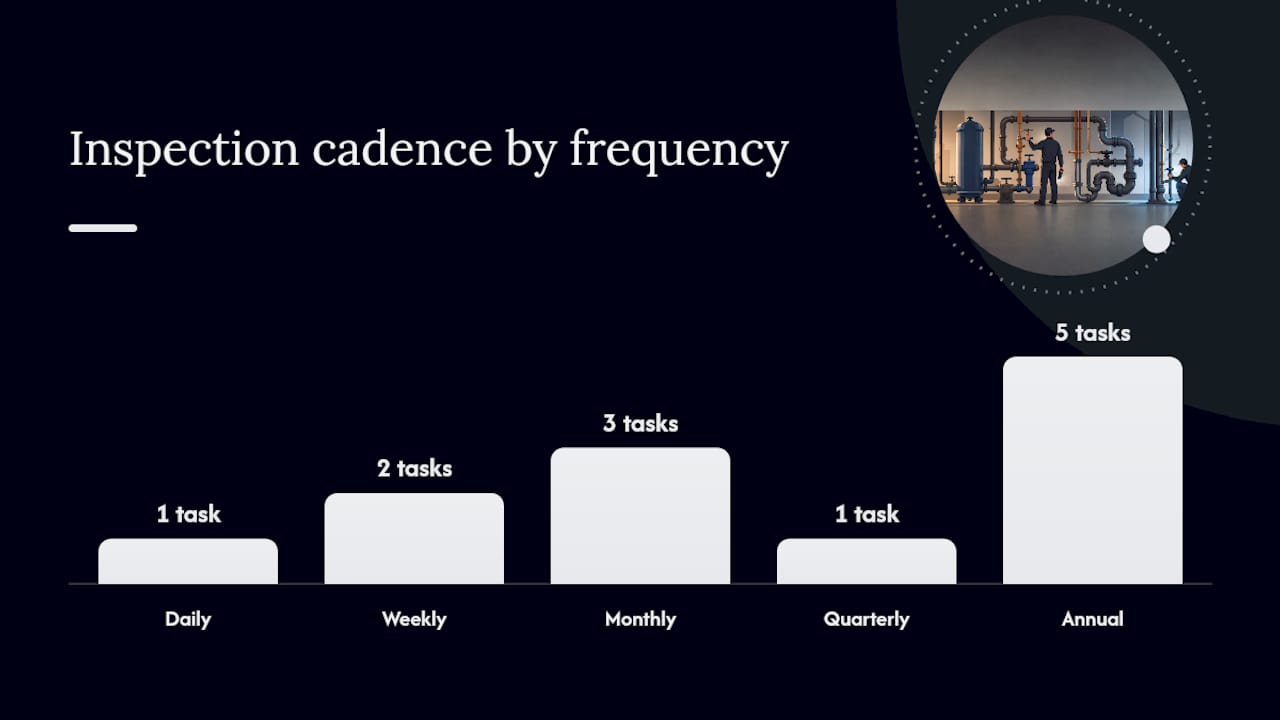
| Asset | Frequency | Who performs it |
|---|---|---|
| Backflow prevention assemblies | Annual (certified test) | Licensed backflow tester |
| Grease interceptors | Per manifest schedule (kitchen volume dependent) | In-house tech or licensed hauler |
| Emergency eyewash/showers | Weekly activation, annual inspection | In-house tech |
| Water heaters | Semiannual | In-house tech |
| Sump pumps | Monthly | In-house tech |
| Main drains and cleanouts | Monthly visual, annual camera | In-house tech / vendor for camera work |
| Recirculation pumps | Quarterly | In-house tech |
Minimum log fields: date, asset ID, technician name, findings, and corrective action taken. Anything less leaves gaps that regulators and insurance auditors will notice.
- Reserve camera inspections and heavy interceptor pumping for planned low-occupancy windows
- Cross-reference every completed task against your plumbing infrastructure asset list so nothing falls through a gap between departments
What Should You Do When a Plumbing Problem Shows Up?
Speed matters more than perfection in the first five minutes. Here is the quick triage sequence for the issues facility teams see most.
- Clogs and slow drains. Check the nearest cleanout first. If water backs up at multiple fixtures on the same line, isolate that branch and call for a camera inspection before reaching for chemicals.
- Active leaks. Shut the nearest isolation valve, not the main, unless the leak is at the main itself. Deploy wet vacs immediately, and call a restoration vendor if water has reached drywall or flooring.
- Low water pressure. Check whether it is isolated to one fixture (likely a clogged aerator) or building-wide (likely a pressure-reducing valve failure or a partially closed main valve).
- Noisy or vibrating pumps. Shut down and inspect for cavitation, worn bearings, or a failing check valve before restarting. Running a failing pump often turns a repair into a replacement.
- Gurgling drains or sewer gas odor. This usually signals a venting problem or a partial main line blockage. Do not ignore it. Escalate to hydro-jetting or camera inspection if the smell persists after a basic drain flush.
Shut off water to the entire building only when the source cannot be isolated at a branch or fixture, or when structural damage is a real risk.
How Should You Manage Valves and Tag Them for Emergencies?
A valve nobody can find during an emergency might as well not exist. Exercise every isolation and control valve on a quarterly cycle: full open, full close, position logged in your CMMS.
- Tag every valve with a unique ID, its function, and the zone it controls
- Map each tag to a current riser diagram or as-built drawing, not a version from three renovations ago
- Space labels for easy reading from standing height, not buried behind pipe insulation
- Size access panels so a technician can physically reach the valve stem, not just see it
MIT’s design standards require chainwheel operators on valves mounted higher than 7 feet, since nobody should be climbing a ladder mid-emergency to shut off water.
Pro Tip: Always lock out and tag equipment before servicing any valve tied to a pump or heater circuit. A valve that looks isolated on paper can still be live if someone forgot to de-energize the connected equipment.
What Documentation Do You Need for Commissioning and Audits?
Every facility needs a searchable, electronic set of operations and maintenance records, not a binder gathering dust in a closet. At minimum, keep bookmarked O&M manuals, a current valve tag schedule, system riser diagrams, an equipment list with model and serial numbers, and signed test certificates.
- Backflow test certificates, renewed annually or per local requirement
- Hot water temperature verification logs tied to your Legionella program
- Chlorination and disinfection records for any new or repaired potable piping
- Pressure test results from commissioning or major repairs
Store these documents where both your maintenance team and an outside auditor can find them in minutes, not days. Boise State’s plumbing design guidelines treat this kind of documentation as a design requirement, not an afterthought, and that mindset should carry into daily operations.
What Is the Safest Way to Handle Drains and Cleaning Chemicals?
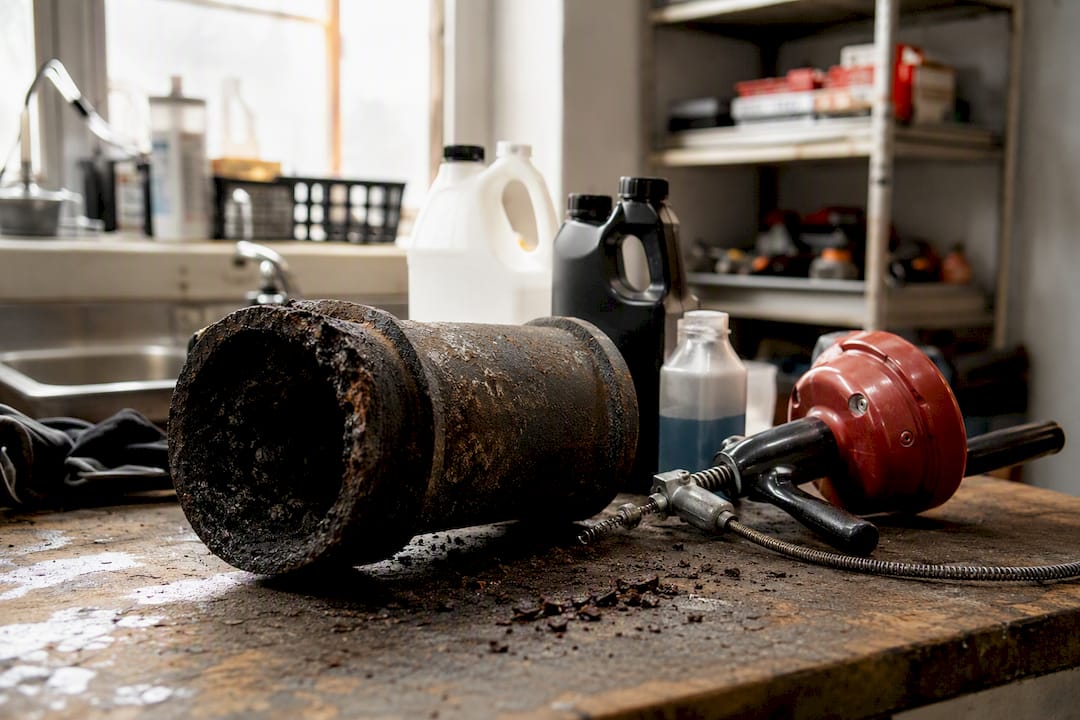
Mechanical methods beat chemical ones almost every time. Strainers, manual snaking, and enzymatic cleaners protect pipe walls; caustic drain openers do not, especially in older galvanized or cast-iron systems where repeated use accelerates corrosion.
- Use strainers and manual removal as your first line of defense
- Reserve hydrojetting for grease buildup or root intrusion a snake cannot clear
- Avoid caustic oxidizers on pipes older than 20 years or of unknown material
- Post occupant signage near kitchens and break rooms to keep grease and wipes out of drains
Grease interceptors need a fixed pumping schedule with a manifest on file for every service, and reducing occupant-driven grease load through simple signage cuts interceptor strain between services.
Pro Tip: Match the drain-cleaning method to pipe age and material. Enzymatic cleaners work fine on PVC but do little for a grease clog in 40-year-old cast iron, where mechanical clearing is the only reliable fix.
What Should Procurement Specs Require for Facility Plumbing Materials?
Specs written for durability and serviceability save far more money over ten years than specs written for the lowest upfront bid. Require lead-free valves on every potable water line, stainless steel for fast-cycling components, and pipe materials matched to the specific application, not a one-size-fits-all default.
- Require unions or flanges at every equipment connection so a pump or heater can be swapped without cutting pipe
- Specify isolation valves at every fixture group, not just at the main
- Build in minimum clearance around equipment, generally two feet, for realistic maintenance access
- Demand test certificates, a spare parts list, and a recommended maintenance schedule from every supplier
Choosing durable, well-documented parts up front, whether that means reliable siphon and trap components or properly rated isolation valves, cuts emergency repair calls down the line.
How Do You Choose a Reliable Plumbing Contractor?
Ask about certification scope before anything else: backflow testing certification, hydrojetting experience, and licensing specific to your jurisdiction. Confirm emergency response times in writing, and verify insurance limits match your facility’s risk exposure, not just a generic minimum.
- Request a written scope of preventive tasks, not a vague “as needed” clause
- Require documentation deliverables after every visit, including test certificates and photos where relevant
- Lock in emergency call pricing before you need it, not after
- Watch for vendors who hesitate to provide references or dodge questions about response time guarantees
A Facility Manager’s Take on Sequencing These Priorities
Prioritizing this list comes down to one question: what fails loudest if ignored? I push valve exercising and backflow testing into the CMMS first, since those carry the highest compliance and safety exposure. Heavy work like camera inspections gets scheduled for low-occupancy windows, always balanced against code deadlines so nothing slips past a renewal date.
Where to Source Reliable Plumbing Parts for Facility Maintenance
Once your checklist is built, the weak link is often the parts drawer. Cheap strainers clog faster, undersized isolation valves fail under pressure, and mismatched cleanout covers mean another service call in six months. Santehnikasveikals stocks valve tags, isolation valves, strainers, and cleanout hardware built to the same specs outlined above, lead-free where potable water demands it, rated for commercial cycling, not just residential use.

Compare specs before you order rather than defaulting to whatever shows up first in a search. Replacement siphon components, bidé and urinal traps, and heating system accessories are all listed with the technical details your procurement spec requires, so you can match part numbers to your existing risers instead of guessing. Browse the full plumbing and construction materials catalog and place your next order for parts that match the standards your facility already runs on.
Sources
For deeper design and testing requirements, keep these on hand: ASHRAE Standard 188 for Legionella water management programs, ANSI Z358.1 for emergency eyewash and shower testing, EPA WaterSense for fixture efficiency guidance, and institutional design standards from MIT, UC Davis, and the VA for valve tagging, commissioning, and freeze protection detail.
- Division 22 - Plumbing Design Guidelines (Boise State University)
- UCDH Facility Standards — Mechanical/Plumbing
Palikite komentarą