





















































Water Supply Planning Guide for Homes and Businesses

TL;DR:
- Effective water supply planning involves careful demand estimation, infrastructure budgeting, and early permit engagement. Regular updates and adaptive strategies ensure long-term resilience, while governance and maintenance are critical to system success. Sourcing reliable components and building emergency storage further support system sustainability.
Water supply planning is the process of designing and managing water systems to meet projected demand reliably and sustainably. Whether you are building a single home or a commercial facility, the decisions you make before the first pipe goes in the ground determine whether your system performs for decades or fails under pressure. This guide covers the core steps: estimating demand, selecting infrastructure, navigating permits, and building in long-term resilience. The standard industry term for this discipline is water resource management, and treating it as a formal process rather than an afterthought saves significant time and money.
What does a water supply planning guide actually cover?
A water supply plan is a structured document that maps current and future water needs against available sources, infrastructure capacity, and regulatory constraints. It is not a one-time design exercise. The most effective plans treat water resource management as a living process that adapts to population growth, climate shifts, and new regulations. Skipping any of the core planning steps creates gaps that surface as expensive failures during construction or operation.
How to estimate water demand and account for peak usage
Accurate demand estimation is the foundation of every effective water supply strategy. The standard benchmark is 135 liters per capita per day for urban areas and 70 liters per capita per day for rural areas. Both figures require an additional 15–25% buffer to account for system losses such as pipe leakage and evaporation.
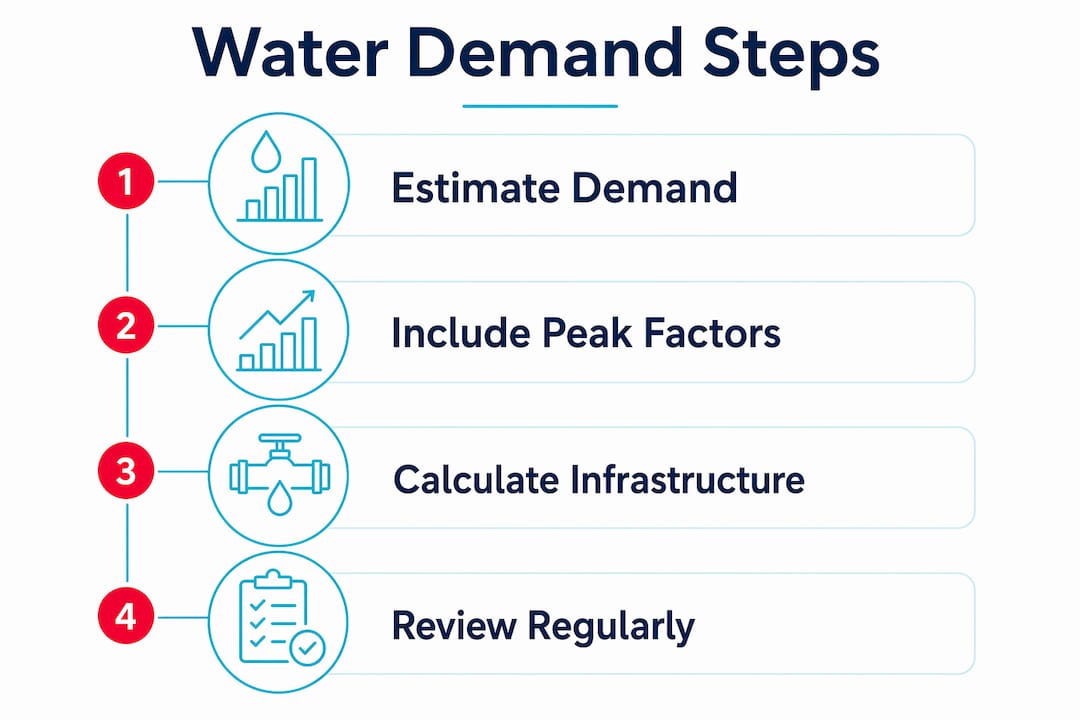
Average daily demand, however, is not the number that sizes your infrastructure. Peak demand factors drive system design: maximum daily demand equals 1.8 times the average daily demand, and maximum hourly demand equals 2.7 times the average daily demand. That gap between average and peak is where under-designed systems fail.
For residential projects specifically, engineers size systems to deliver daily consumption within a 2-hour peak window. That means your pipes, pumps, and storage must handle the full day’s projected use compressed into a single morning rush. Ignoring this requirement produces systems that run dry or lose pressure exactly when demand is highest.
Key inputs for a reliable demand estimate include:
- Current population or occupancy count with a 20-year growth projection
- Usage category breakdown (residential, commercial, irrigation, fire suppression)
- Seasonal variation factors for properties with significant summer or winter demand swings
- Loss allowance of 15–25% added on top of net consumption figures
Pro Tip: Revisit your demand forecast every five years. Population shifts, new appliances, and behavioral changes can move actual consumption well outside the original design assumptions, leaving you either over-built or critically short.
What are the key components of a water supply system?
Understanding plumbing infrastructure components helps you budget accurately and avoid design gaps. Every water supply system consists of four core elements: the source (well, municipal connection, or surface water intake), pumping systems, storage tanks, and the distribution pipeline network.
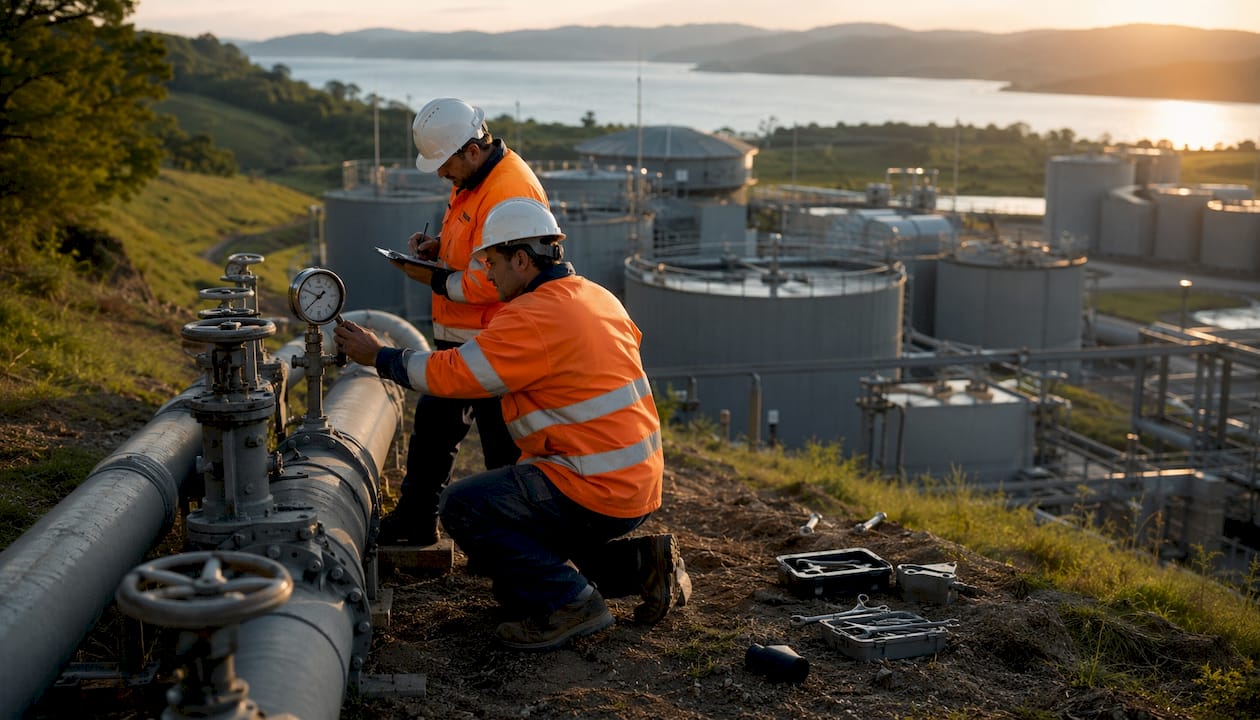
Design lifespan benchmarks matter for long-term budgeting. Transmission mains carry a 30-year design life, while treatment plants are typically rated for 15 years. Planning replacement cycles from day one prevents the budget shock of replacing major assets without reserves in place.
The cost split surprises most first-time planners. Distribution infrastructure accounts for roughly 50% of total project costs. That means the pipes running through walls and under ground consume as much budget as the source, pumps, and storage combined. Underestimating this figure is the single most common cause of mid-project budget shortfalls.
| Component | Typical design lifespan | Cost share notes |
|---|---|---|
| Transmission mains | 30 years | High upfront material and installation cost |
| Treatment plants | 15 years | Requires planned replacement reserves |
| Pumping systems | 10–20 years | Maintenance-intensive; factor in energy costs |
| Storage tanks | 20–30 years | Size to cover peak demand plus emergency reserve |
| Distribution pipelines | 25–50 years | Often 50% of total project investment |
Smart metering and leak detection technology, covered in depth in the smart plumbing advantages guide, adds operational flexibility by flagging losses in real time before they become structural failures.
Pro Tip: Build modular capacity into your storage and pumping design. A system sized for today’s demand with no expansion provision will require full replacement rather than simple upgrades when demand grows.
What permits do you need for a water supply project?
Regulatory compliance is not optional, and starting the permit process late is one of the most expensive mistakes in water supply project management. Most jurisdictions require formal permits for any water diversion or withdrawal exceeding 100,000 gallons per day for 30 or more consecutive days. That threshold applies to many mid-size commercial and agricultural projects, not just large municipal systems.
The practical steps for navigating permits include:
- Start regulatory consultation during the planning phase, not after design is complete. Changes required by regulators after design is finalized cost far more than early adjustments.
- Identify the relevant state or regional water authority early. In the United States, state-level agencies issue withdrawal permits, and requirements vary significantly by jurisdiction.
- Document your demand calculations using the peak factor methodology described above. Regulators expect to see maximum daily and hourly demand figures, not just averages.
- Assess environmental impact on source water bodies, including downstream flow requirements and aquifer recharge rates.
- Budget for permit timelines. Complex projects can face review periods of six months to over a year. Build this into your project schedule.
Long-term water resource planning should balance growth, supply resilience, and environmental protection principles to satisfy both regulators and community stakeholders. Projects that demonstrate environmental stewardship move through review faster and face fewer objections.
How do you build a sustainable and adaptive water supply strategy?
Integrated water cycle management treats demand reduction, water reuse, and infrastructure investment as a single coupled system rather than separate decisions. This approach is now the standard for projects seeking long-term resilience. A system that captures and reuses greywater, for example, reduces the load on its primary source and extends the effective life of storage infrastructure.
Adaptive planning takes this further by treating the water supply plan as a document that evolves. Adaptive frameworks incorporate climate scenarios, emerging regulations like PFAS standards, and new technology rather than locking in assumptions made at the design stage. A plan written in 2020 that does not account for updated contaminant thresholds or drought projections is already outdated.
Practical adaptive strategies include:
- Leak detection programs using pressure monitoring to identify losses before they become visible failures
- Smart metering at the zone level to track consumption patterns and spot anomalies in real time
- Phased infrastructure expansion that adds capacity in planned increments rather than requiring full replacement
- Demand management incentives such as tiered pricing or efficiency rebates to reduce peak load
Sustainable water system success often fails due to weak governance, demand management, and maintenance, not technical failures alone. Designing accountability and maintenance capacity into the project from day one is what separates systems that last from systems that fail within a decade.
The 2026 roadmap on sustainable water management confirms this directly. Technical excellence without governance structures and community buy-in produces systems that degrade faster than their design life predicts.
Step-by-step guide to planning and executing a water supply project
A well-executed water supply project follows a defined sequence. Skipping steps or reordering them creates rework that costs more than the time saved.
- Collect baseline data. Gather population counts, current consumption records, source water quality data, and topographic surveys. This data drives every downstream decision.
- Forecast demand. Apply the 1.8x daily and 2.7x hourly peak factors to your average daily consumption figure. Add the 15–25% loss buffer. Document your assumptions.
- Select source and treatment approach. Match source water quality to treatment requirements. A groundwater source with high iron content needs different treatment than a clean municipal connection.
- Produce technical drawings. Engage a licensed engineer to produce pipe sizing calculations, hydraulic grade line analysis, and equipment specifications.
- Estimate costs with distribution in focus. Allocate roughly half your budget to the distribution network. Use the cost-saving plumbing ideas framework to identify value engineering opportunities without compromising performance.
- Submit permit applications. File with the relevant state or regional authority. Include your demand calculations and environmental impact assessment.
- Procure materials and contractors. Specify materials by standard rather than by brand where possible. This keeps procurement competitive and simplifies future replacement.
- Install and commission. Follow the water pipe installation steps for smaller residential sections. For main distribution lines, use licensed contractors and pressure-test every segment before backfilling.
- Establish an operations and maintenance plan. Define inspection intervals, replacement triggers, and emergency response procedures before the system goes live.
The CDC recommends maintaining at least 1 gallon per person per day for three days as a minimum emergency water reserve. Build this into your storage sizing from the start rather than treating it as an afterthought.
Key Takeaways
Effective water supply planning requires accurate peak demand sizing, realistic infrastructure budgeting, early regulatory engagement, and adaptive governance built in from day one.
| Point | Details |
|---|---|
| Size for peak, not average | Design to 1.8x daily and 2.7x hourly demand factors, not average consumption figures. |
| Budget 50% for distribution | Allocate roughly half of total project costs to the distribution pipeline network. |
| Start permits early | File permit applications during the planning phase; review periods can exceed six months. |
| Treat the plan as a live document | Update demand forecasts and regulatory assumptions every five years to stay current. |
| Build in emergency storage | Include at least 1 gallon per person per day for three days as a minimum reserve. |
What I’ve learned from watching water projects succeed and fail
— Renate
The projects I’ve seen fail most often were not technically deficient. The pipes were sized correctly, the pumps were specified properly, and the permits were filed. What collapsed was the governance layer: nobody owned the maintenance schedule, nobody updated the demand forecast after the first year, and nobody had authority to act when a leak was detected.
The growing complexity of water quality standards, particularly around PFAS contaminants, makes this worse. A system designed five years ago may now be out of compliance with updated thresholds, and the only way to catch that is to treat your water supply plan as a document you revisit, not one you file and forget.
Smart metering changes this dynamic significantly. When you can see consumption data at the zone level in real time, you catch anomalies before they become failures. That is not a technology argument. It is a maintenance argument. The technology just makes the maintenance easier to do consistently.
My honest recommendation: spend as much time designing your operations and maintenance framework as you spend on the technical drawings. The pipes will last. The question is whether the people and processes around them will.
— Renate
Water supply products and components at Santehnikasveikals
Planning a water supply system is only half the work. Sourcing the right components at the right price determines whether your project stays on budget.

Santehnikasveikals carries a wide range of plumbing and water supply products suited for both residential and commercial projects, including pumping accessories, storage solutions, pipe fittings, and distribution components. The catalog covers everything from individual fittings to full system components, with delivery available across Latvia. Whether you are specifying materials for a new build or replacing aging infrastructure, Santehnikasveikals provides the product range and pricing transparency to keep your project on track.
FAQ
What is the standard per capita water demand for planning?
The standard benchmark is 135 liters per capita per day for urban areas and 70 liters per capita per day for rural areas. Both figures require an additional 15–25% buffer for system losses.
When does a water project require a permit?
Most jurisdictions require a permit for any water withdrawal exceeding 100,000 gallons per day sustained over 30 or more consecutive days. Start the permit process during the planning phase, not after design is complete.
How do peak demand factors affect system sizing?
Maximum daily demand is calculated at 1.8 times the average daily demand, and maximum hourly demand at 2.7 times the average. Residential systems must also be sized to deliver the full day’s projected consumption within a 2-hour peak window.
How long do water supply infrastructure components last?
Transmission mains carry a 30-year design life, while treatment plants are typically rated for 15 years. Pumping systems last 10–20 years depending on maintenance, and distribution pipelines can last 25–50 years.
What is the minimum emergency water storage recommendation?
The CDC recommends at least 1 gallon per person per day for a minimum of three days as an emergency water reserve. Factor this into storage tank sizing from the start of the project.
Оставьте комментарий